Mon–Fri: 10:00 – 18:00
 Request a call



SEO for law firms is the work of getting a practice found by people who are looking for a lawyer today, usually within a few miles of the office, usually during the worst week of their year. Search matters more in legal than in almost any other industry, because paid clicks for personal injury, immigration and family law are among the most expensive Google sells. A law firm that ranks organically pays for the SEO work once and keeps the placement. A firm that does not rank pays per click, every click, for as long as the ads run.

Global One Digital is a five-person SEO and automation team based in Tbilisi. We do seo for law firms in the United States, Europe and the CIS, in English and Russian, and we run everything in writing: email or WhatsApp, no mandatory calls. Below: what law firm seo involves, what it costs, and where it stops being worth the money.
What law firm SEO covers
Law firm seo has four moving parts, and most firms are strong in one and empty in the other three. Technical health decides whether search engines can read and trust your law firm website at all. Local SEO decides whether your firm appears in the map pack for «divorce lawyer near me». Content decides which practice areas and which cities your firm can compete in. Authority, meaning links and mentions from sources that matter in your jurisdiction, decides how far up the search results your law firm can go once the rest is in place.
The order matters. Publishing thirty articles on a site Google cannot crawl is money spent on nothing, so every engagement starts with an SEO audit rather than a content calendar. Our crawler runs about 90 checks on a law firm website: redirect chains, duplicate titles, thin content, canonical mistakes, broken internal links, mobile speed, and gaps between your sitemap and what Google holds in its index.
One boundary worth naming early. If you sell legal software rather than legal services, see our SEO for LegalTech page: that work targets buyers of case management platforms and contract automation, and runs on product content and trial signups. Everything here is about a law firm that takes clients.
Local SEO for lawyers with one office or five
For most practice areas the map pack sits above the organic results and takes the majority of the clicks. Getting in is a different job from ranking a page: Google builds the map pack on proximity, prominence and relevance, and only one of those is something your firm can change quickly.
A single office is straightforward: a Google Business Profile with the right primary and secondary categories, consistent name, address and phone across legal directories, photos that are not stock, and a steady flow of reviews. Firms often set the primary category to «Law Firm» when «Personal Injury Attorney» or «Immigration Attorney» would earn far more map impressions. That one field is worth checking before anything else.
Multi-office firms are where local seo gets awkward. Each office needs its own profile, its own location page on your website, and content genuinely about that city: the courts your lawyers appear in, local filing rules, the staff who sit there. Publish five city pages with the city name swapped out and Google ranks one and ignores the near-duplicates. We treat every office as a separate mini-project with its own keyword set and its own local SEO checklist, and never launch a location page for an office with no staff in it. A suspended profile costs more than that page was going to earn.
Practice area pages and attorney profiles
Practice area pages
A practice area page should answer the question a worried person types at 11pm, then make the next step obvious. Results in the top ten for legal queries typically run 2,000 to 5,000 words, and that length is rarely padding: statute of limitations in that state, recoverable damages, how fees work, what happens if the case settles. A 400-word summary saying the team is dedicated and experienced competes with nothing.
Depth also means splitting. «Personal injury» is a hub. Car accidents, truck accidents, slip and fall and wrongful death are separate URLs with separate demand and case values. Our text relevance analyzer compares a draft with the top ten for its target query and reports which terms the ranking pages use that your draft does not, so every law firm seo brief comes from the search results rather than from guesswork.
Attorney bios
These profiles attract branded searches, referral checks and a surprising share of conversions: people look up the lawyer before they call the firm. A bio listing bar admissions, year of admission, law school, reported cases and languages spoken converts the reader and feeds the trust signals search engines look for on YMYL content. Third-person bios with no dates and no admissions do neither.
E-E-A-T, YMYL and the higher bar on legal content
Legal content sits in the YMYL category, meaning pages that can affect someone’s finances, rights or safety. Google’s quality raters apply stricter standards there, and the ranking systems trained on their judgments follow. The first E in E-E-A-T is Experience, which in legal means showing that the lawyer has actually run these matters, not that the firm has opinions about them. In practice, a law firm page with no named, credentialed author has a ceiling that no amount of SEO lifts.
What we implement on a law firm website: every substantive page signed by a real attorney and linked to their bio; bar admissions and jurisdictions stated in full; review dates on anything about law that changes; client reviews pulled from platforms where they can be verified, not typed into the theme; office address, registered entity and phone visible rather than buried in a contact form. None of this gets invented. If the firm does not have it, we say so and publication waits.
Advertising rules change what you can publish
Attorney advertising is governed by the bar rules of each jurisdiction, and those rules differ enough to break a template. Some states require a disclaimer on anything showing past results. Some restrict «specialist» and «expert» unless the lawyer holds a certification. In England and Wales the SRA sets transparency requirements on price and complaints information that apply directly to your law firm website.
We are not your compliance counsel. What we do is flag the relevant rule in each draft, send it for approval before publication, and keep a record of what was approved.
Ready to win Google traffic?
Free 30-minute strategy call. We will tell you what is realistic for your niche, your budget and your timeline — before quoting any work.
What our law firm SEO services include
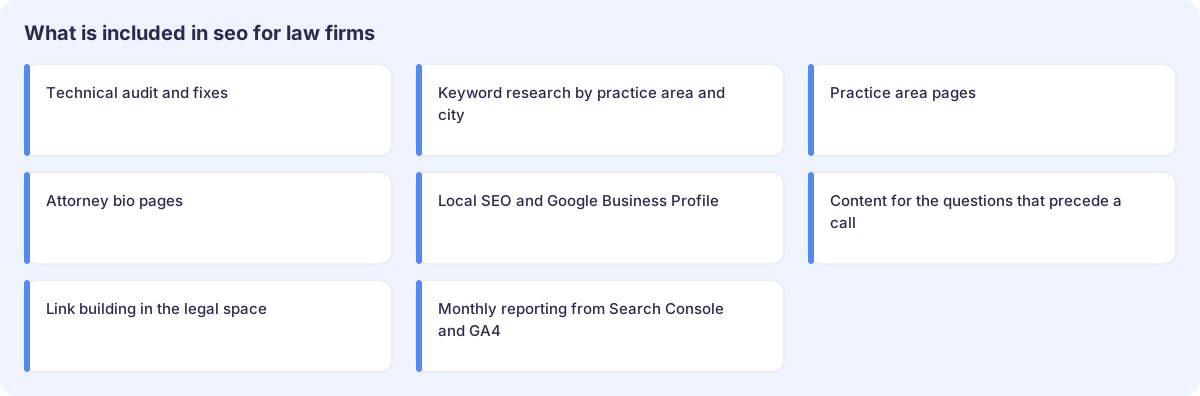
Technical audit and fixes
About 90 crawler checks on your law firm website plus a written fix list with priorities. Crawl and indexation problems get handled first, by us or by your developer. Full scope on technical SEO.
Keyword research by practice area and city
Search volumes from Keyword Planner, intent split into hiring, researching and comparing, and a map of which URL owns which cluster so two of them never compete for one query.
Practice area pages
New sections for services with real demand, rewrites for those already ranking at positions 6 to 20, where a few added terms move more traffic than a new URL would.
Attorney bio pages
One template with admissions, credentials, cases and publications, written from what your team supplies, with structured data so search engines can read the credentials.
Local SEO and Google Business Profile
Category selection, profile completion, legal directory citations, a review workflow, and a location page for every office with staff in it.
Content for the questions that precede a call
Guides, process explainers and FAQ content that catches people earlier in the decision, planned through content marketing.
Link building in the legal space
Bar association profiles, legal directories that pass value, law school profiles, local press, guest articles your peers read. No link farms or private blog networks. Details on link building.
Monthly reporting from Search Console and GA4
Impressions, clicks and positions by URL and practice area, plus form submissions and calls where tracking exists. The accounts stay yours, so every number can be checked.
How we work
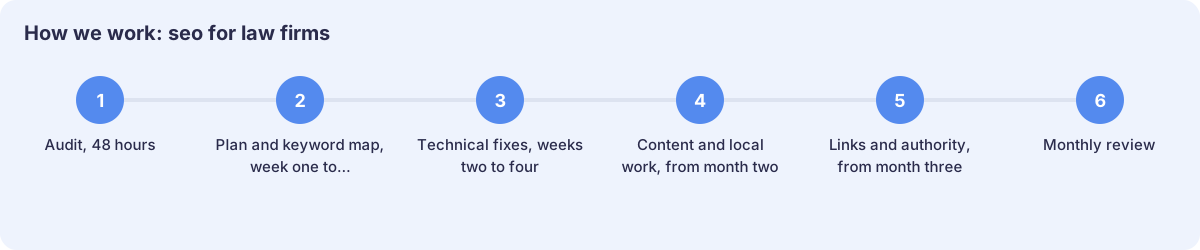
- Audit, 48 hours. You send access to Search Console, GA4 and the site. You get a written document: technical blockers, the queries your firm already appears for, where competitors outrank you and why, and a prioritized fix list. Fixed price, no call required.
- Plan and keyword map, week one to two. Practice areas and cities scored by demand and by how hard the current top ten looks. You approve the section-by-section plan in writing before anything gets written.
- Technical fixes, weeks two to four. Crawl errors, speed, internal linking and indexation first, so later content lands on a site search engines can process.
- Content and local work, from week five. Drafts ship in batches, each reviewed by your side for accuracy and bar compliance before publication. Profiles and citations get corrected in parallel.
- Links and authority, from week nine. Directory, association and publication placements build gradually. Nothing is bought in bulk.
- Monthly review. One written report, one prioritized list for the next cycle. Anything that gained impressions but no clicks gets its title and snippet rewritten before anything new is built.
Legal SEO results come slowly. A new page on an established site can collect impressions within weeks, but stable rankings for competitive, high-value practice area queries take six to twelve months, and personal injury in a large US metro can take longer. Anyone promising position one in ninety days is selling branded queries or selling nothing.
Traffic is only half the job
Legal marketing has a leak that no amount of search engine optimization fixes. Intake studies in the profession keep finding the same pattern: a large share of inbound enquiries go unanswered for hours, and by then the caller has contacted another firm. Your law firm can rank first and still lose the case to whoever picked up.
So we build intake automation as well. Our AI intake assistant for law firms answers the first enquiry in seconds, asks the questions your intake staff would ask, screens out matters you do not take, and hands a structured summary to a human. SEO and intake work as one system. Ranking well and leaving the form unread until Monday is an expensive way to fund someone else’s practice.
Pricing for law firm SEO
We charge a fixed monthly fee: no percentage of revenue, no lock-in period, no charge per lead. The fee depends on how many practice areas and offices are in scope.
A solo practitioner or a small law firm with one office usually fits an SEO care plan: for US clients those are $350, $600 and $1,200 a month, with prices for other countries listed there. Firms with several offices or practice areas in a large metro get quoted after the audit, and B2B programs in Europe start at €1,500 monthly on our pricing page. The audit is a separate fixed-price product, $149 for a single page and $399 for a full site for US clients, delivered in writing within 48 hours.
Who seo for law firms suits, and who should skip it
It fits a law firm with a real caseload and the capacity to take more: personal injury, immigration, family law, employment, corporate, criminal defence. It fits practices in the US and Europe run by Russian-speaking founders who want reporting in either language without a translator in between. It fits firms willing to give an attorney an hour every four weeks to review drafts.
It does not fit a firm that needs cases next week with no organic base to build on, where Google Ads will help faster and we will say so. It does not fit practices unwilling to publish anything under a named lawyer. And it does not fit anyone who wants rankings without touching the website, because on a site nobody may change, very little lasts.
Frequently asked questions about SEO for lawyers
How long before seo for lawyers brings actual cases?
First impressions on new content usually show within four to eight weeks. Enquiries tend to start after about a quarter, and competitive practice area rankings take six to twelve months. Map pack movement is often the fastest part, sometimes within weeks of fixing a profile, because that is a data problem rather than an authority problem.
Is attorney SEO different from SEO for other businesses?
The mechanics are the same. The constraints are not. Legal content is YMYL, so author credentials carry more weight; bar advertising rules limit what can be published; and one client can be worth more than a year of ecommerce traffic, which changes what a sensible law firm seo budget looks like.
Should our firm write the content, or should you?
We write, an attorney reviews. Lawyers who write their own copy write accurately and for other lawyers; agencies that publish without review get the law wrong. Review runs about twenty minutes per page once the template is settled.
Do you guarantee first position?
No, and nobody can. What we commit to is the numbers from your own Search Console and GA4, reported monthly, so you can see what moved. If the law firm seo work is not paying after six months you can stop, since no contract holds you.
What about AI Overviews? Do people still click through to law firms?
Clicks on informational queries are down where AI answers appear. Hiring queries have held up better, because someone choosing a lawyer wants to see the firm. Being cited in AI answers depends on much the same signals: direct answers near the top of the page, structured data, a site the models can parse. That sits under LLM SEO, included rather than sold as an extra.
We are redesigning our website. Should we wait?
Talk to us before the redesign, not after. Rebuilds are where firms lose rankings they took years to earn, usually through changed URLs with no redirects. We ran a migration for a studio that kept every position and grew visibility from 794 to 4,754 impressions a month; the same checklist applies to a law firm website.
To find out where your law firm actually stands, send your site and the practice areas you care about to info@development-web.com, or order the written audit and have the answer in 48 hours. Sometimes the honest recommendation is to spend the budget on ads instead. We will say so.
More SEO services
- SEO services
- SEO audit
- SEO consulting
- Technical SEO
- On-page SEO
- Off-page SEO
- Link building
- Local SEO
- SEO copywriting
- Keyword research
- Content marketing
- International SEO
- Ecommerce SEO
- Amazon SEO
- Marketplace SEO
- Mobile SEO Services for Sites That Lose Rankings on Phones
- App Store Optimization Services for Apps That Need Organic Installs
- LLM SEO
- Monthly SEO plans
- SEO migration
- Dental SEO
- Shopify SEO
- B2B SaaS SEO
- LegalTech SEO
- Small business SEO
- Healthcare SEO
- Real estate SEO
 Download brief
 Print brief