Mon–Fri: 10:00 – 18:00
 Request a call


App store optimization services exist because Apple gives you 30 characters for an app name, 30 for a subtitle and 100 for a hidden keyword field, and most apps waste at least one of them. App store optimization (ASO) is the work of making an app rank in App Store and Google Play search and then convert the people who land on its page: keyword research, metadata, screenshots and preview video, localization by country, and a plan for ratings and reviews. Global One Digital does this for publishers who want organic installs to carry more of the acquisition budget. We write natively in English and Russian, set up Apple Search Ads on request, and do not promise a number of installs, because nobody honest can.

What ASO covers, and what it does not
Two stores, two algorithms. The App Store indexes the app name, subtitle and keyword field, plus the developer name and the names of in-app purchases. The description is not used for search on iOS; it only has to convince. Google Play indexes the title, the short description and the full description, so on Android the long text carries ranking weight and has to be written with search in mind, without turning into a keyword list that gets the listing flagged.
Both stores then weigh behavior. Download velocity, conversion from page view to install, rating average and rating count matter on both. Google Play also watches retention and uninstalls, which means an app that people delete after a day slides down no matter how good the metadata is. That is the first honest limit of ASO: it cannot fix the product.
The second limit is volume. If you need 50,000 installs by launch week, organic store search will not deliver that and paid acquisition will. Apple Search Ads can be run as a paid complement, and its search term reports feed the organic keyword work, but paid and organic results are always reported in separate columns so you know what each one brings.
App Store versus Google Play: the fields that decide rankings
Apple App Store
- App name, 30 characters. The strongest ranking field; the brand plus the one phrase you most need to rank for.
- Subtitle, 30 characters. Second-strongest field, shown under the name in search results.
- Keyword field, 100 characters, comma separated, never shown to users. Words already in the name and subtitle should not be repeated here.
- Promotional text, 170 characters, changeable without a new release. Useful for seasonal offers.
- Description, up to 4,000 characters, not indexed. Written for conversion only.
- Up to 10 screenshots and up to 3 app previews per device size; the first two or three are what most people see.
- Custom product pages, up to 35, each with its own screenshots and promotional text, for different audiences or ad campaigns.
Google Play
- Title, 30 characters, the strongest field on Android as well.
- Short description, 80 characters, indexed and shown above the fold on the listing.
- Full description, up to 4,000 characters, indexed. Keyword placement matters here in a way it does not on iOS.
- Up to 8 screenshots per device type, a feature graphic and an optional promo video.
- Store listing experiments, Google’s native A/B testing for icons, screenshots and text.
- Custom store listings by country or by traffic source, and ratings that are shown per country and per device type.
What is included in app store optimization services
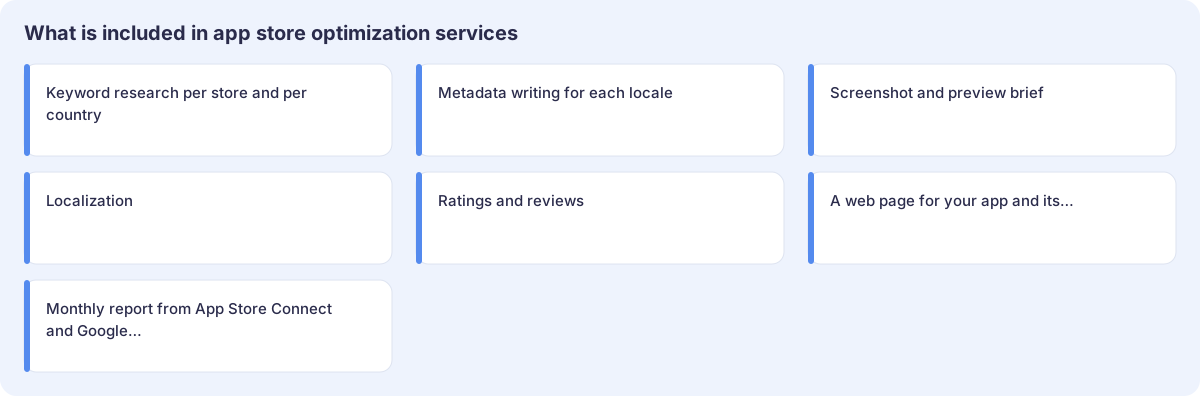
- Keyword research per store and per country: competitor metadata, store suggest data collected with our own parsers, Apple Search Ads search term reports where a campaign exists, and Google trends for seasonality.
- Metadata writing for each locale: name, subtitle, keyword field, short and full description, with a version history so you can see what changed and when.
- Screenshot and preview brief: caption copy and a storyboard for the first three screens, plus what the icon must communicate at 60 pixels. Design production is done by your designer or by a contractor we coordinate.
- Localization: English and Russian written natively by our team, other languages with native editors, and a check that each localized keyword set actually reflects how people search in that country rather than a translated list.
- Ratings and reviews: when to trigger the in-app rating prompt, reply templates for the review section, and when a ratings reset on a new iOS version makes sense.
- A web page for your app and its SEO: a landing page that Google can rank for the app’s name and category, with smart app banner, Android app links and structured data.
- Monthly report from App Store Connect and Google Play Console: impressions, page views, conversion rate, installs by source and by country, keyword positions for the tracked set.
Not included: fake reviews, install bursts, rating manipulation. All of these violate store policies and get apps removed. We will decline the request rather than risk your developer account.
Localization by country, in English and Russian first
Both stores rank per storefront and per language, so app store optimization is done country by country. A keyword set that works in the US store does nothing in Germany, and a machine-translated one does little anywhere. Russian-language metadata reaches App Store and Google Play users in Kazakhstan, Uzbekistan, Georgia, Armenia and the Russian-speaking communities across the EU and US, which is a large audience most Western publishers never localize for. We write those two languages ourselves; Turkish, German and others go through native editors with our keyword research underneath.
The same two-language approach is how we build websites. A dental clinic whose bilingual site we launched got its first clicks from Google the day after going live; the case study describes the setup. Store listings behave similarly: a properly localized listing starts appearing for local queries within days of the release being approved.
Ready to win Google traffic?
Free 30-minute strategy call. We will tell you what is realistic for your niche, your budget and your timeline — before quoting any work.
Your app’s web page and Google search
Google indexes App Store and Google Play listing pages, and it also ranks your own landing page for the app. That page is the piece most publishers skip. A good one has the app name plus the job it does in the title, real screenshots with alt text, a short FAQ, SoftwareApplication structured data, the iOS smart app banner and Android app links so a visitor on a phone lands in the store or the app in one tap. The general SEO rules apply, the page must pass the checks described under mobile SEO, and with AI assistants increasingly recommending apps by name, the page is also what LLM SEO works from.
How we work on app store optimization
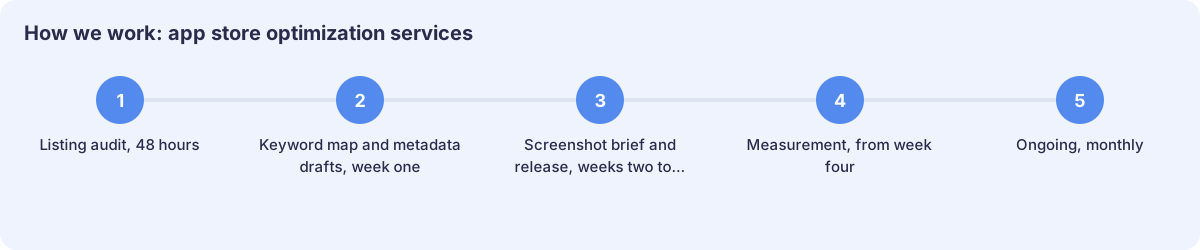
- Listing audit, 48 hours. You send the store links and, ideally, read access to App Store Connect and Google Play Console. You receive a written document: which keywords the app ranks for, which fields are wasted, how the screenshots compare with the top five competitors, and what to change first. Everything is by email or WhatsApp.
- Keyword map and metadata drafts, week one. For each store and locale you get a keyword set with estimated relevance and competition, a proposed name and subtitle, and description drafts. You comment in writing; a call is optional.
- Screenshot brief and release, weeks two to three. Captions and storyboard go to the designer, the metadata goes into the next release, and the Google Play changes go live without waiting for a build.
- Measurement, from week four. Keyword positions are tracked weekly, conversion rate and installs monthly. On Google Play, store listing experiments run on screenshots and short description; on iOS, custom product pages test alternative angles.
- Ongoing, monthly. Metadata refresh with each release, new locales, seasonal promotional text, review replies, and a report you can verify against your own console data.
Pricing
App store optimization is priced as a flat monthly fee based on the number of stores and locales, with no percentage of revenue and no long contract. A single app in one or two languages fits the care plans: in the US that is $350, $600 or $1,200 a month depending on scope, with local prices shown for other countries. Apps with many locales, or publishers with a portfolio, get a custom quote after the audit. The audit alone is a fixed-price product: the page audit at $149 for US clients covers one listing on one store, and the full audit at $399 covers both stores and the app’s web page. Apple Search Ads management is quoted separately and only if you ask for it.
Who ASO services are for, and who should not hire us
A good fit for app store optimization services: apps already live with at least a few hundred installs, so there is behavior data to work with. Publishers who want to enter Russian-speaking markets or bring a Russian-language app to the US and EU with metadata written by people who read both. Small teams whose developer also does the marketing and has never opened the keyword field. Companies whose app is one channel of a business that also has a website, where the store listing and the site should reinforce each other.
Not a fit: apps with no working product yet, because there is nothing to measure. Publishers who want guaranteed rankings or a set number of installs. Anyone looking for review or install manipulation. And if the app does not exist yet, start at mobile app development; the store listing gets planned there alongside the build, which is cheaper than retrofitting it.
Frequently asked questions about app store optimization
How long does app store optimization take to show results?
Google Play metadata changes are reindexed within days, and keyword positions usually move within two weeks. On iOS the changes ship with a release, so timing depends on your release cycle and App Review. Meaningful movement in installs, as opposed to positions, usually takes two to three months, because conversion signals accumulate slowly.
What is the difference between ASO and SEO?
SEO gets a web page ranked in Google; ASO gets an app listing ranked inside the App Store or Google Play. The stores have far fewer ranking inputs, no backlinks and much stronger weight on conversion and ratings. They overlap where Google indexes your listing and your app’s landing page, which is why we handle both sides.
Do you guarantee installs or a top position?
No. Rankings depend on competitors, on store algorithm changes and on how people react to the app once installed, and none of that is under an ASO agency’s control. What you get is a documented process, keyword positions you can verify in your own console, and an honest monthly note about what worked.
Is Apple Search Ads part of the service?
Only on request. We can set up and run Apple Search Ads campaigns, and the search term data they produce is useful for the organic keyword work. Paid and organic are billed and reported separately so the organic result is never hidden inside a paid spike.
How much does ASO cost?
The audit is $149 or $399 for US clients, and monthly work runs from $350 a month under the care plans. The exact figure depends on the number of stores and locales, and you will see it in writing before anything starts. Prices for other countries are shown on the pricing pages.
Can you get us more positive reviews?
More reviews from real users, yes: by timing the rating prompt after a successful action in the app rather than at first launch, replying to existing reviews, and fixing the issues that repeat in one-star reviews. Purchased or incentivized reviews, no. Both stores detect them and the penalty is removal.
Which tools do you use for ASO?
App Store Connect and Google Play Console for the real numbers, Apple Search Ads search term reports where campaigns exist, our own parsers for store suggest and competitor metadata, and Google Search Console for the app’s web page. The tools matter less than reading the console data every month and acting on it.
To see how much of your metadata is currently wasted, send the store links to info@development-web.com or order a written ASO audit. It comes back within 48 hours with the keyword map and the first round of changes, and you can take it to your own team or have us do the work.
More SEO services
- SEO services
- SEO audit
- SEO consulting
- Technical SEO
- On-page SEO
- Off-page SEO
- Link building
- Local SEO
- SEO copywriting
- Keyword research
- Content marketing
- International SEO
- Ecommerce SEO
- Amazon SEO
- Marketplace SEO
- Mobile SEO Services for Sites That Lose Rankings on Phones
- LLM SEO
- Monthly SEO plans
- SEO migration
- SEO for law firms
- Dental SEO
- Shopify SEO
- B2B SaaS SEO
- LegalTech SEO
- Small business SEO
- Healthcare SEO
- Real estate SEO
 Download brief
 Print brief