Working hours Mon–Fri: 10:00 – 18:00

Free SEO check · 18 checks

See what’s holding your page back

Free — five checks an hour. We read only the public page, exactly the way a search engine does. Nothing is stored unless you ask us to email the report.

  • 18 checks
  • Results on screen
  • No sign-up
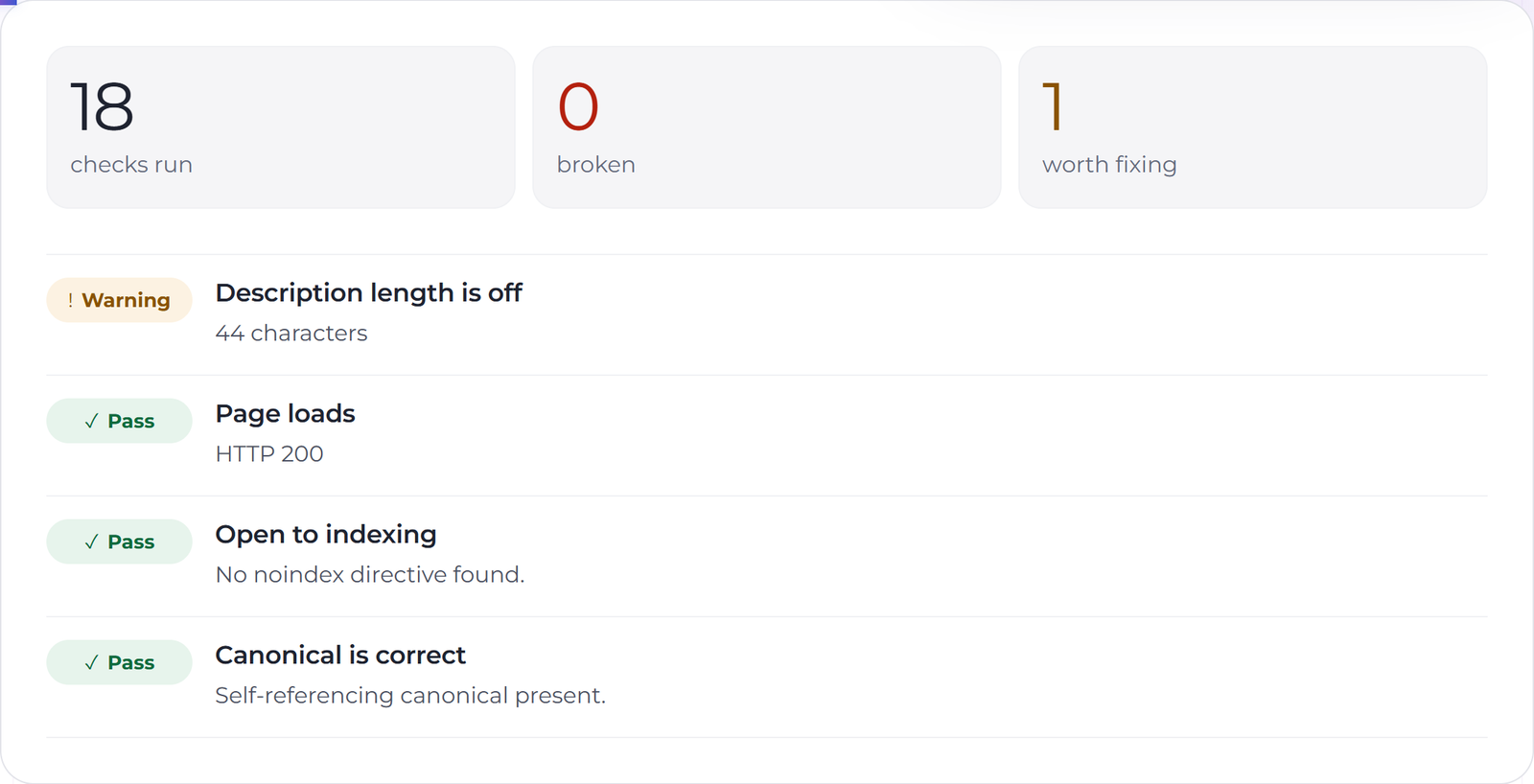
Result of a real check: 18 checks run, 0 broken, 1 worth fixing, with each finding marked pass or warning

We only read the public page

One request to the URL you paste — the same request Googlebot makes. No login, no crawl of the rest of your site, nothing written anywhere unless you ask for the report by email.

A person stands behind it

Built and run by Alex, founder of Global One Digital. In SEO since 2014, 175 projects. The checker is the first step of the audit we sell — the same checks, run by hand and taken further.

See the paid work before you pay

The $149 audit has a published sample report — real findings on a real page, not a template. Read it first and decide whether it is worth the money.

What is inside

Eighteen checks, seven groups

Weighted the way search engines meet a page: first whether it can be reached at all, last whether it is polished.

Width of each block = how many of the 18 checks fall into that group.

Indexing4 checks

Page loads · Open to indexing · Canonical · robots.txt

Meta and language3 checks

Title length · Description length · Language declared

Content and links3 checks

Image alt text · Content volume · Internal linking

Speed and weight3 checks

Server response · HTML size · Mobile viewport

Headings2 checks

H1 present · Subheadings present

Markup2 checks

Structured data · Open Graph

Security1 check

HTTPS with no mixed content

What this SEO checker looks at

The tool loads your page the way a search engine would — no JavaScript rendering, no login, just the public HTML — and runs about twenty checks against it. Every issue it finds is shown on screen straight away. Nothing is held back to make the report look worse than it is.

The checks fall into six groups:

Indexing

Whether the page can be crawled and indexed at all: the HTTP status, redirect chains, a noindex directive left over from staging, the canonical tag, and whether robots.txt blocks Googlebot. This group matters most — a page closed from indexing cannot rank no matter how good it is.

Meta

Title and description length, and the language declared in the html tag. A title outside 55–65 characters gets truncated in search results, and a missing description hands Google a free hand to write its own.

Headings

Whether there is exactly one H1, whether it merely repeats the title, and whether the text is broken into H2 sections. We have found live pages where section titles were styled as plain divs — search engines saw a wall of text with no structure.

Markup

Structured data in JSON-LD and Open Graph tags. Schema is how search engines and AI assistants understand what the page is; Open Graph decides how the link looks when someone shares it.

Content

Word count, image alt text and internal linking. Thin pages rarely compete, and pages nothing links to internally get crawled rarely.

Speed and security

Time to first byte, HTML weight, HTTPS and mixed content.

How to read the result

Each check comes back as one of three states. Critical means the page is losing its ability to rank right now — an error status, a noindex directive, a robots.txt rule that blocks the whole site. Needs work means the page still works but is leaving something on the table. Fine means we looked and found no problem.

Fix critical items first, in the order the report lists them. There is no point improving a title on a page that search engines are told to ignore. Once indexing is clean, the meta and heading issues are usually an hour of work with visible effect; content and link problems take longer.

The full report — every issue with the specific fix and the order we would tackle them in — is sent to your email. That is deliberate: it keeps the on-screen result honest and short, and it means the recommendations arrive somewhere you can forward them to whoever does the work.

What a page checker cannot tell you

This is a single-page tool, and we would rather say so than pretend otherwise. It checks the URL you give it. It does not crawl your whole site, so it cannot see duplicate pages competing with each other, keyword cannibalisation between sections, orphan pages nothing links to, or broken links elsewhere in the structure.

It also does not compare you against whoever currently outranks you. Most pages that sit outside the top ten are not broken — they are simply thinner or less specific than the pages above them, and no automated checker can measure that gap. Relevance against the current top of the search results needs real analysis of those competitors, not a checklist.

And it says nothing about authority. If a domain has no links pointing to it, its pages can be technically perfect and still rank on page four. We have seen exactly that on sites we run ourselves: every check green, positions stubborn, because the bottleneck was never on the page.

When the checker is enough

For a new page you just published, or a page that suddenly dropped, this check catches the obvious causes fast — a stray noindex, a broken canonical, a redirect chain, a robots.txt rule from staging. Those account for a surprising share of «why did my traffic disappear» cases.

When you need more than a checker

If the technical side is already clean and rankings still will not move, the answer is in relevance and links rather than in tags. That is what our paid SEO audit covers: your page measured against the pages currently ranking for its main keyword, over-optimisation checked in both directions, and a prioritised fix list your copywriter can act on. Fixed price, delivered in writing within 48 hours.

How we use this tool ourselves

Everything the checker looks for, we have found on our own site at some point. Section headings that were not headings. Nine English pages declaring themselves Russian in the html lang attribute. An article reachable at two URLs, splitting over a thousand impressions between them. A homepage heading stuck on a template default for four months because a field name was off by one character.

That is the honest case for running a check like this regularly: these problems are boring, invisible in the browser, and they quietly cost traffic for months. You can read the full report from our own audit — real findings, real numbers, including the ones that were embarrassing.

Common questions

Is this SEO checker really free?

Yes. Five checks per hour per visitor, no account needed to see the findings on screen. We ask for an email only to send the report with the fixes, because that also tells us the address is real.

Do you store the pages you analyse?

We keep the URL and the result of the analysis so the report can be sent and so we know what to write about if we follow up. We do not store the page content itself.

Why does the tool check only one page?

Because a single page returns an honest answer in seconds. A full crawl takes minutes and needs limits to avoid hammering your server. If you want the whole site examined, that is the paid audit, where a person reads the output rather than a script printing it.

Can I check a competitor’s page?

Yes, any public URL works. Running the same check on the page currently outranking you is a fast way to see whether they are winning on technical quality or on something the checker cannot measure.

What if the checker finds nothing wrong?

Then it says so. A clean result is useful information: it means the next place to look is content relevance and links, not tags. We would rather tell you that than invent problems to justify a follow-up.

After the check: what to do next

An SEO checker is a snapshot. What moves rankings is what you do with it, and the order matters more than the volume of work. Once the critical items are cleared, three things are worth your attention.

1

Track what actually changed

Note the date you shipped each fix and watch positions for the affected keywords over the following weeks. Without that, you will never know which change helped. Search Console shows impressions and average position per query for free; that is enough to track progress without buying a monitoring product.

2

Measure page performance properly

Our checker reports time to first byte and HTML weight, which catch the crude problems. Real user performance — the Core Web Vitals that Google measures — needs field data over time, so pair this with PageSpeed Insights on your key templates rather than on every page.

3

Look at links, not just pages

When the technical checks come back clean and rankings still will not move, the constraint is usually authority. That means backlink research: who links to the pages outranking you, and whether anything credible links to yours. No on-page checker can see this, and no amount of tag polishing substitutes for it.

Using the checker as a team

Agencies and in-house teams use a page checker differently. In an agency it is a triage step before quoting work — run it, see whether the problem is cheap or structural, and price honestly. In-house it works better as a release gate: check every new landing page before it goes live, because the issues this tool finds are far cheaper to fix before a page has accumulated links and rankings.

Either way, keep the reports. Comparing this month’s SEO checker output against last month’s is the simplest form of monitoring there is, and it costs nothing.

Free checker or paid audit — how to choose

Start with the free checker. It takes seconds, and if it finds something critical you have your answer without spending anything. Use it to analyze any page you are about to publish, and to learn which of the basics your site gets wrong repeatedly — most sites have a pattern.

Move to the paid audit when the checks come back clean and you still need to improve positions. The difference is not more features: it is a person comparing your page against the ones outranking it, deciding what to optimize and in what order. Pricing is fixed and published on the audit page — $149 for a single page, $399 for a site — with no retainer and no call required.

How far each step goes

The free check is the first tier, not a smaller version of the audit

Each step answers a question the one before it cannot.

Free check “Is anything on this page broken?”

18 automated checks on the live URL. Answers in about a minute, costs nothing.

Page audit — $149 “Why do those ten pages outrank mine?”

Your page read against the ten currently ranking: what they cover and you do not, where you over-optimised, what to fix first.

Site audit — $399 “Where is the whole site losing search traffic?”

The same comparison across every page that matters, plus crawl budget, internal linking and the order to work through it.

Where the free tool stops

A machine sees what is missing. It has no opinion on what is good.

That is the honest limit of every free checker, ours included — and it is exactly where the paid audit starts.

This page

Free SEO check

18 automated checks · instant · no sign-up

  • Whether the page can be crawled and indexed at all
  • Titles, descriptions, headings, markup, alt text
  • Response time and page weight on the live URL
  • Whether you beat the pages ranking above you
  • Whether anyone searches the query you target
  • Whether the domain is trusted enough to rank
Run the free check
Paid audit

SEO audit, fixed price

$149 one page · $399 whole site · in writing within 48 hours

  • Everything the free check does, verified by hand
  • Your page compared against the ten currently ranking
  • Words and topics the top ten cover and you do not
  • Over-optimisation: where you pushed a keyword too far
  • A fix list ordered by expected impact, not by category
  • A re-measure after you implement, at no extra cost
See what the audit looks like
Sample report

Read the deliverable before you buy it

Most agencies describe an audit. We published one. It is a real page, real findings and the real order we would fix them in — including the parts where the answer was leave it alone.

If the sample does not tell you something you did not already know, do not buy the audit. That is a better test than any sales page.

Open the sample report
SEO AUDIT — yoursite.com Prioritised fix list · 12 findings 1 2 3

One URL. Eighteen checks. About a minute.

You will know within the minute whether anything is structurally blocking the page — and whether it is worth paying anyone to look deeper.

Free, five checks an hour. No sign-up.