Custom UI Components and Design Systems for B2B SaaS
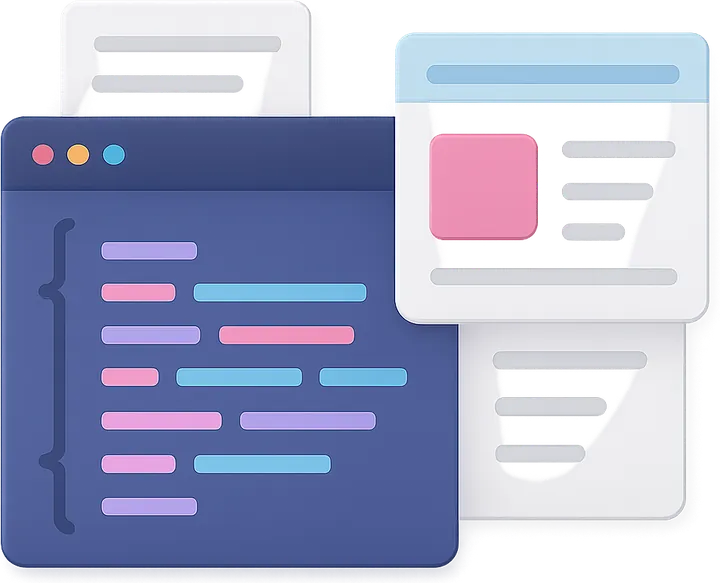
Custom UI Components Development from Global One Digital builds bespoke UI components and design systems for B2B and SaaS applications across the USA, EU and CIS. We work in React, Vue and Web Components, with Storybook documentation and accessibility baked in from the start. Components ship as part of a coherent design system that your engineering team can extend rather than as one-off snippets.
When custom UI components make sense
Off-the-shelf component libraries (Material UI, Ant Design, Chakra, Mantine, Radix) cover 70-80% of typical patterns well. Custom components matter when your brand needs visual identity that template libraries cannot match, when accessibility requirements exceed what most libraries deliver out of the box, when interaction patterns are unusual (specialised data-entry, complex visualisations, industry-specific workflows), or when your application complexity calls for a coherent design system rather than ad-hoc styling decisions.
What our component engagements include
Standard scope covers design token system (colour, type, spacing, motion), component API design that fits your team patterns, implementation in your framework of choice, Storybook documentation with usage examples and edge cases, accessibility testing (keyboard navigation, screen reader, focus management), automated visual regression testing, integration into your build pipeline, plus team training on extending the system without breaking it.
Stack expertise across modern frontend
React with TypeScript, hooks-first patterns, modern context and state management. Vue 3 with composition API. Web Components for framework-agnostic distribution when components need to work across multiple application stacks. Styling via CSS-in-JS (Emotion, styled-components, vanilla-extract), CSS modules, or Tailwind depending on team preference. Build pipelines on Vite or webpack with proper tree-shaking so consumers only pay for what they import.
Why design systems usually fail
Most design systems fail because they ship without governance — engineers build pages outside the system, designers add new variants without updates, documentation goes stale within months. Our engagements include governance processes (component request workflow, contribution guidelines, breaking-change protocol), ongoing maintenance retainers where helpful, and team workshops to align engineers and designers on the same vocabulary.
Accessibility as engineering, not as marketing
WCAG 2.2 AA compliance is the baseline. Components ship with proper ARIA attributes, keyboard navigation, focus management, screen reader testing, colour contrast verification and motion-reduce support. Automated tests run in CI to prevent regressions. We test on real assistive technology (NVDA, VoiceOver, JAWS) rather than relying on automated checkers alone.
No juniors learning on your project. Every engagement is led by people who have shipped 30+ similar projects.
Transparent process and reporting
Weekly updates, monthly reviews, clear scope. You always know what is being done and why.
B2B and SaaS focus
We work with growing businesses — not enterprise bureaucracy, not consumer apps. Our process fits your scale.
USA, EU and CIS markets
Time zones overlap with US East and Central Europe. We deliver in English and Russian.
Modern stack, no legacy traps
React, Next.js, Laravel, Node, Python and modern WordPress. No vendor lock-in, no proprietary framework dead-ends.
Long-term partnership, not project flings
Most clients work with us for 2+ years. We document everything, hand off cleanly and stay reachable for what comes next.
Who we build for
B2B SaaS founders
Growing B2B teams
DTC and ecommerce operators
Russian-speaking entrepreneurs
How we build websites and web apps
1
Discovery call
2
Audit and proposal
3
Build / implementation
4
Launch and handover
5
Ongoing optimization
Frequently asked questions
-
How long does a typical project take?
A landing site: 4-6 weeks. A mid-size web app or ecommerce platform: 8-12 weeks. Complex multi-language platforms: 16+ weeks. Discovery call narrows it down for your specific scope.
+
What technology stack do you use?
For frontend: React, Next.js, Vue, Nuxt. For backend: Node, Laravel, Python, PHP. For CMS: WordPress (mature) and Strapi (headless). We pick the stack that fits your project, not the other way round.
+
Will you work with our existing developers?
Yes. We frequently embed into existing engineering teams, work in your repository, follow your code review process and hand off cleanly when our work is done.
+
Do you provide design or just development?
Both. We have senior designers who specialise in B2B and SaaS. If you already have design (Figma, Sketch), we work directly from your files.
+
What does post-launch support look like?
Every project includes a bug-fix window (1-3 months depending on tier). After that we offer maintenance retainers from $400/mo. Most clients stay on a retainer for ongoing iteration.
+
Can you migrate our existing site to a new platform?
Yes. Migrations are a regular part of our work — WordPress to headless, Wix to Shopify, custom CMS to modern stack. We preserve content, redirects and SEO equity.

 Mon–Fri: 10:00 – 18:00
  Request a call


 Download brief
  Print brief