Mon–Fri: 10:00 – 18:00
 Request a call



Shopify seo services deal with a platform that quietly works against you. Every product in a Shopify store sits at two addresses, /products/handle and /collections/whatever/products/handle, and most Shopify themes link to the second. Shopify sets the canonical to the first, so the duplicate rarely costs rankings, but your internal links and crawl budget point at URLs Google is told to ignore. That is the shape of most shopify seo work: the platform decided something for you, and someone has to undo it.

Global One Digital is a five-person seo and automation team in Tbilisi. We do shopify seo for stores in the United States, Europe and the CIS, in English and Russian, entirely in writing, at a fixed monthly price with no contract. Below: what breaks on Shopify, what our shopify seo services include, and what they cost.
One scope note first. For non-Shopify stores and general ecommerce strategy, see ecommerce SEO. If you need the store built rather than optimized, that is online store development. This page is about the platform.
Shopify duplicate product URLs and canonicals
The within_collection problem is the first thing any shopify seo audit should check. When a Shopify theme renders product links inside a collection, Liquid often produces the collection-scoped URL. Googlebot then crawls thousands of duplicate paths, spending its budget on URLs that will never rank while new products wait to be discovered. A search engine rations crawling per site, and Shopify happily spends yours on copies of what it already has.
The fix is a Shopify theme edit: output product.url rather than the collection-scoped version, and keep the canonical tag in the layout file clean. On a store with a few hundred products the effect is invisible. At ten thousand SKUs it decides whether new products index in days or in months.
Two related Shopify traps. The platform creates a redirect when you change a product handle only if the option is ticked, and staff renaming products in bulk often untick it. And /collections/all exists whether you use it or not, duplicating the catalog under a page nobody meant to link to.
Shopify collections, tags and faceted navigation
Shopify collections carry commercial search demand far more than product pages do, and that demand is high-intent. «Men’s merino base layers» is a collection query. «SKU-4471» is not. So collection structure is where most shopify seo planning goes: which collections exist, what each is named, which keyword each owns, and what the page says above the product grid.
Tag filtering is where it falls apart. Shopify’s older tag filters generate crawlable URLs like /collections/jackets/blue+waterproof, and every combination multiplies them. Newer storefront filtering uses query parameters, cleaner but still crawlable. Left alone, a Shopify store with forty tags produces more filter URLs than it has products, all thin duplicates of the parent collection.
The approach that works: pick the handful of filter combinations with real search volume, give each one a proper collection with its own title, description and internal links, and keep the rest out of the index. Everything else gets blocked or canonicalized. This is ordinary technical SEO, but Shopify’s constraints change which tool does the job.
Shopify robots.txt.liquid: what you can change
Shopify lets you edit robots.txt.liquid in the template files, which is more control than the platform used to give. You can add disallow rules for filter patterns, remove a default rule, and add sitemap directives. You cannot rewrite the file freely, and you cannot use it to clear pages already indexed, since a blocked URL is never recrawled to see the noindex.
Order matters. On a Shopify store with a filter mess we noindex first, wait for Google to process it, then block the pattern in robots. The other way round leaves thousands of filter URLs stuck in the index. The Shopify sitemap has its own limits: generated automatically, not editable, and products hidden from the online store sales channel silently drop out of it.
Shopify theme speed and the apps that eat it
Shopify hosting is fast. Shopify themes usually are not, and the reason is almost always apps. Every review widget, email capture popup, currency converter and loyalty tool injects scripts into every page, including pages where the app does nothing. Uninstalled apps leave tags behind in the Shopify theme, so stores carry code from tools they stopped paying for a year ago.
Our Shopify speed work is unglamorous: audit which apps load on which templates, strip leftovers from uninstalled apps, move what can move to conditional app embeds, defer what need not run before first paint, resize the hero image somebody uploaded at 4000 pixels wide. Mobile Core Web Vitals is the target, since that is what Google measures and what customers feel. Performance is a sales question as much as a ranking one: a store that paints in four seconds on a phone loses orders before position matters, and the checkout experience suffers with it.
We do not promise a perfect Lighthouse score. Shopify scripts and the apps you genuinely need set a floor, and any seo agency claiming 100 on a live Shopify store has tested a page you do not sell from.
Structured data, reviews and the Shopify blog
Most Shopify themes ship partial Product schema, missing availability, condition or brand, and review apps add AggregateRating in a block that conflicts with the storefront’s own markup. Two Product objects on one page is a common reason rich results stop showing. We consolidate into one valid graph per Shopify template: Product with offers and ratings, BreadcrumbList sitewide, Organization once.
The Shopify blog at /blogs/ is underused, and it is where informational demand lives. Buying guides, sizing and comparison content catch people who are not ready to buy, then link into the collections that sell. We plan it as content marketing rather than a blog nobody reads, and it is what earns links, since nobody links to a product page. Off-site seo runs through link building: digital PR, stockist pages, guest articles your buyers read.
Migrations to Shopify and away from it
Replatforming is where stores lose years of seo in a weekend. Shopify forces its own URL structure, so a migration from WooCommerce or Magento changes every product, category and blog URL. Without a complete redirect map you lose the lot.
Our migration process: crawl the old site, export every URL with its traffic and links from Search Console and Ahrefs, build the redirect map before launch, preserve titles and descriptions, launch, then recrawl and monitor indexation daily for a month. We ran this for a tattoo studio that kept every position and grew visibility from 794 to 4,754 impressions a month across the move. The platform differs; the seo checklist does not.
Migrations away from Shopify work the same way: the seo risk is identical, and the planning happens before anyone touches the new store.
Ready to win Google traffic?
Free 30-minute strategy call. We will tell you what is realistic for your niche, your budget and your timeline — before quoting any work.
Shopify Markets, domains and currencies
Selling into several countries means deciding how Shopify markets split. Shopify Markets serves localized versions on subfolders like /en-de/ or on separate country domains, and generates hreflang for translated markets. The common shopify seo mistake is switching on a market that changes only the currency, producing near-identical pages for the US and Canada that compete with each other.
So we decide which markets deserve real localized content, set hreflang so each market’s pages point at each other correctly, and keep the rest as currency switching without separate indexable URLs. The wider strategy sits on our international SEO page. We write English and Russian natively and use native editors elsewhere, because a machine-translated German catalog does not rank in Germany.
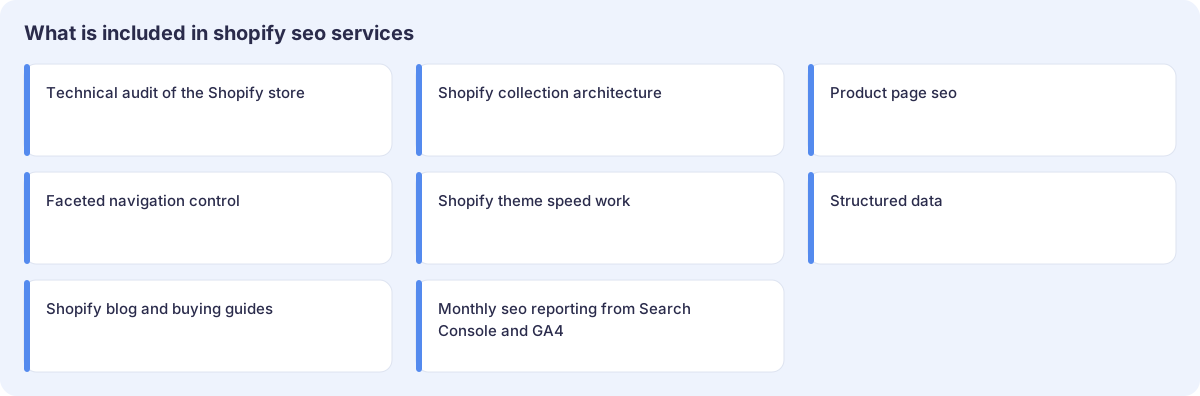
What our Shopify SEO services include
Technical audit of the Shopify store
About 90 crawler checks plus platform-specific ones: canonical handling, collection-scoped product URLs, filter URLs in the index, sitemap coverage against the real catalog, redirect chains from old handles.
Shopify collection architecture
Keyword research from Keyword Planner and the search results, mapped to a collection plan where each page owns one cluster and no two collections compete for one query.
Product page optimization
Titles, meta descriptions and copy written for search and for buyers, replacing supplier text that twenty other Shopify stores already use word for word.
Faceted navigation control
Shopify filter patterns audited, valuable combinations promoted to real collections, the rest kept out of the index through noindex and robots rules in the right order.
Shopify theme speed work
App audit, removal of leftover scripts, conditional loading and image handling, measured on mobile Core Web Vitals rather than a desktop score.
Structured data
One valid schema graph per Shopify template, with Product, offers, ratings and breadcrumbs, so the store is eligible for rich results and readable by AI answer engines.
Shopify blog and buying guides
Informational content that catches demand before the purchase and links into the collections that convert.
Monthly seo reporting from Search Console and GA4
Impressions, clicks, positions by collection and product, organic revenue where ecommerce tracking exists. The accounts stay yours.
How we work
- Shopify SEO audit, 48 hours. You send store and analytics access. You get a written document: what is indexed that should not be, what is not indexed that should be, and which collections have demand you are missing, in the order the fixes should happen. Fixed price, no call required.
- Keyword and collection map, week one to two. Demand per collection, difficulty of the current top ten, and a page-by-page seo plan you approve in writing before anything ships.
- Technical fixes, weeks two to four. Shopify theme edits, canonical and filter handling, redirect cleanup, speed work. We work on an unpublished copy and you approve before it goes live.
- Shopify collections and product pages, from month two. Copy ships in batches so you can check the first set before the rest. Bulk changes go through CSV or the API rather than by hand.
- Content and links, from month three. Guides and comparison pages publish on a schedule; off-site placements build gradually rather than arriving in one week.
- Monthly review. Written, with the next batch attached. Pages with impressions and no clicks get titles rewritten before new pages get built.
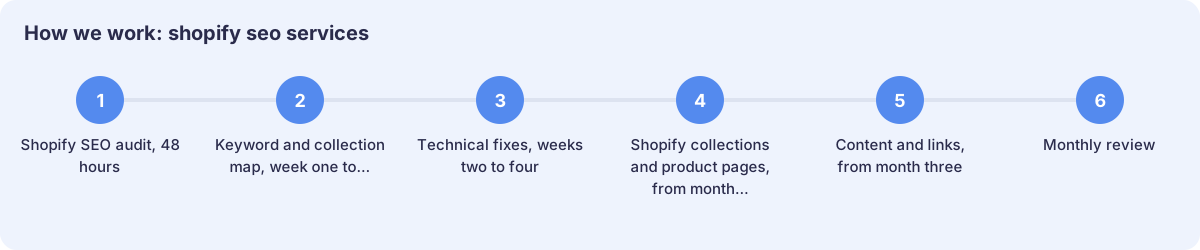
Shopify seo timelines: technical fixes move indexation within weeks, collection rankings take three to six months, competitive categories longer. Seasonal stores need the work done a quarter before the season, not during it.
What Shopify SEO results look like
We publish the numbers we have, not the ones that would sell better. One ecommerce client scaling content reached 320,580 impressions and 5,993 clicks from Google in a quarter, written up in scale content marketing. The numbers come from a Search Console account the client controls.
What we will not do is promise a revenue multiple. Organic revenue depends on margin, prices against the competition and conversion rate, and a shopify seo agency quoting a return before seeing your store is guessing.
Shopify SEO pricing
Shopify seo is a fixed monthly fee, set by catalog size and how many collections are in scope. No percentage of revenue, no per-lead pricing, no six-month lock-in.
Smaller Shopify stores fit one of our SEO care plans: for US clients $350, $600 or $1,200 a month, with other countries priced on that page. Larger catalogs, Shopify Plus and multi-market setups are quoted after the audit, and B2B programs in Europe start at €1,500 a month on our pricing page. The seo audit is a separate fixed-price product, $149 for a page and $399 for a full store for US clients, in writing within 48 hours. For a free first look, run any URL through our site analyzer.
Who our shopify seo services fit, and who should skip them
Shopify seo services fit a business with products people actually search for, a margin that survives a marketing budget, and someone who can approve theme changes. They fit stores grown past the point where the founder writes every collection page, and Russian-speaking founders selling in the US or Europe who want reporting in either language.
They do not fit a brand-new store with no products live; get the catalog online first. They do not fit a product nobody searches for by name, where paid social does the job search cannot. And they do not fit anyone who wants rankings without letting us near the Shopify front end, since most of the fixes are template edits.
Frequently asked questions about Shopify SEO
Is Shopify good for seo?
Good enough. Hosting is fast, HTTPS and mobile rendering are handled, meta fields are editable. The limits are real: forced URL structure, an uneditable sitemap, no server-level control, filter URLs that need managing. Most Shopify stores lose more seo to unmanaged apps and thin collections than to the platform.
How long do shopify seo services take to pay off?
Technical fixes show in indexation within weeks. Collection and product rankings move between month three and month six. Competitive categories take a year, and any shopify seo agency quoting faster is describing branded searches you already had.
Do you need access to our Shopify theme code?
Yes, for most of the seo work. We duplicate the live storefront, change the copy, and hand it back for approval before publishing. If your developer prefers to implement the fixes, we write the tickets instead.
What about Shopify SEO apps? Do they replace this?
Shopify seo apps help with specific jobs: bulk meta editing, redirect management, broken link checks. None of them decide collection architecture, write a page that beats the current top ten, or judge which filter URLs deserve to exist. Each one you install also costs page speed.
Can you migrate our store to Shopify without losing rankings?
That is the plan every time, and it depends on the redirect map being built before launch. Crawl the old site, map every URL with traffic or links, test redirects on staging, then launch. Rankings usually dip for a few weeks and recover.
Do you work on Shopify Plus and headless stores?
Shopify Plus, yes. Headless builds on Hydrogen depend on how the front end renders and who controls it, so we look before agreeing: seo work on a headless store runs through your developers rather than the theme editor.
To find out what your store loses to Shopify’s defaults, send the domain to info@development-web.com or order the written seo audit. You get the specific URLs that are wrong, in 48 hours, in writing. If the real problem turns out to be your prices rather than your search visibility, the audit says that too.
More SEO services
- SEO services
- SEO audit
- SEO consulting
- Technical SEO
- On-page SEO
- Off-page SEO
- Link building
- Local SEO
- SEO copywriting
- Keyword research
- Content marketing
- International SEO
- Ecommerce SEO
- Amazon SEO
- Marketplace SEO
- Mobile SEO Services for Sites That Lose Rankings on Phones
- App Store Optimization Services for Apps That Need Organic Installs
- LLM SEO
- Monthly SEO plans
- SEO migration
- SEO for law firms
- Dental SEO
- B2B SaaS SEO
- LegalTech SEO
- Small business SEO
- Healthcare SEO
- Real estate SEO
 Download brief
 Print brief