Mon–Fri: 10:00 – 18:00
 Request a call



The most common problem a client brings to our keyword research services is not a lack of keywords. It is three pages on the same website written for «keyword research services», «keyword research service» and «keyword research agency», which Google treats as one intent. It rotates the three and none of them holds a position. The fix is not a fourth page. It is one keyword map where every cluster of keywords has exactly one page, and every page has exactly one cluster.

That map is what Global One Digital sells under keyword research: demand collected by country and language, cleaned, clustered by what shows up in the search results, prioritized by search volume and cost per click, and turned into a plan of pages with titles and H1s. The output is a document you can hand to a writer or a developer the same day. This page explains what goes into it, how long it takes and what it costs.
What keyword research solves
Keyword research answers four questions a site owner cannot guess: which keywords people type in the target country, how many of them per month, which of those keywords belong on the same page, and which pages to build first. Get the first one wrong and the site talks about «apartments» where the market says «flats». Get the third one wrong and you get the cannibalization described above. Get the fourth one wrong and six months of writing goes into keywords with 20 searches a month while a 4,000-search cluster stays empty.
Free keyword research tools show volumes. A keyword tool does not tell you which of 3,000 keywords share an intent, what to name the page or whether your website can realistically rank for it. That judgment is the service. If you only need numbers, Google Keyword Planner and Search Console are free, and more options are listed on the free SEO tools page.
What is included in our keyword research services
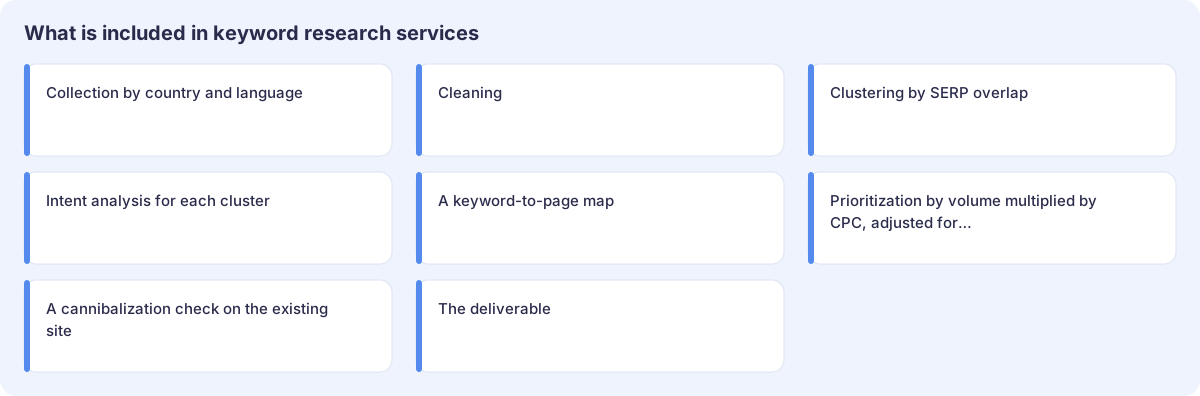
- Collection by country and language: Google Keyword Planner volumes for the specific country (US volumes are useless for the UK or Germany), Google Search Console queries for an existing site, autocomplete keyword suggestions and «People also ask» questions, and the keywords competitors rank for, pulled from Ahrefs or Semrush.
- Cleaning: brand keywords of other companies, job-seeker queries, queries from the wrong region, DIY queries for a service business, and anything below the volume threshold agreed with you.
- Clustering by SERP overlap: two keywords go into one cluster only if Google returns mostly the same URLs for both. This is the step spreadsheet-based grouping gets wrong.
- Intent analysis for each cluster: commercial, informational, navigational or mixed, based on what type of page dominates the top 10 rather than on the wording of the query.
- A keyword-to-page map: each cluster assigned to an existing URL or to a new page, with the main keyword, secondary keywords and a draft title and H1.
- Prioritization by volume multiplied by CPC, adjusted for how strong the current top 10 is and for pages you already rank at positions 6 to 20.
- A cannibalization check on the existing site: pages competing for the same cluster, with a recommendation to merge, redirect or re-target each one.
- The deliverable: a spreadsheet with clusters, volumes, CPC, intent and page assignments, plus a short written memo on what to build first and why.
Clustering by search results: one cluster, one page
Take two keywords, pull the top 10 for each in the target country, count how many URLs they share. Four or more shared URLs out of ten, and Google is telling you these are the same page. Fewer, and they need separate pages, even if the words look like synonyms to a human. «SEO audit» and «SEO audit checklist» share almost nothing in the US results: one is a service, the other is an article. Merging them onto one page means ranking for neither.
The opposite mistake is just as common: splitting «keyword research services», «keyword research company» and «keyword research agency» into three pages when the top 10 for all three is nearly identical. One page, one cluster, all three keywords in the text, the highest-volume one in the title. This is where a keyword list from a tool and a keyword map from a person part ways.
Clustering runs on our own parser of Google results, so it uses the real top 10 for your country rather than a generic database. For a site with 2,000 to 5,000 raw keywords the result is usually 150 to 400 clusters, which is a page plan a team can execute.
How keywords are prioritized
Every cluster gets a score built from search volume, the average CPC advertisers pay for it in Keyword Planner, and the current difficulty of the top 10. CPC is the useful part most lists skip: a keyword with 300 searches and a $40 CPC is worth more to a B2B company than one with 5,000 searches and a $0.30 CPC, because advertisers have already priced the intent. Long tail keywords with clear buying intent sit high on the list even at low volume.
For an existing site there is a second layer. Keywords where the site already shows at positions 6 to 20 in Search Console go first, since a rewrite of an existing page moves faster than a new one. Keywords where the site has zero impressions and the top 10 is all national brands go last, or get cut. The point is a list you can work through from top to bottom and stop when the budget runs out.
Ready to win Google traffic?
Free 30-minute strategy call. We will tell you what is realistic for your niche, your budget and your timeline — before quoting any work.
Keyword research by country and language
Demand does not translate. The English keyword for a service in the US, the UK and Australia is often worded differently, and the volumes differ by a factor of ten. Russian-language demand in Georgia, Kazakhstan, Uzbekistan and the Baltics has its own wording and its own competitors and is collected separately from anything else. German, Spanish, Turkish and other languages are collected with a native editor checking that the keywords mean what we think they mean; a false friend in a keyword list becomes a page nobody wanted.
For a site entering several markets the map is built per country, then compared: which clusters exist everywhere, which exist in one market only, and how the page structure and hreflang should follow. That work continues under international SEO. The team’s own languages are Russian and English; other languages add a native editor and a few days to the schedule.
How we work: from access to keyword map
- Day 1, scope. You send the site, the target countries and languages, and Search Console access if the site exists. We agree the volume threshold and the list of competitors, in writing.
- Days 2 to 4, collection. Keyword Planner by country, Search Console export, autocomplete and «People also ask», competitor keywords from Ahrefs or Semrush. The raw list is typically 2,000 to 10,000 keywords.
- Days 5 to 6, cleaning and clustering. Off-topic keywords removed, the rest clustered by SERP overlap with our parser, each cluster labeled with intent.
- Days 7 to 8, mapping and prioritization. Clusters assigned to existing or new pages, scored by volume, CPC and difficulty; the cannibalization check runs on the current site.
- Days 9 to 10, delivery. The spreadsheet and the memo arrive by email. One round of questions and adjustments is included; most clients use it to move a few clusters between pages.
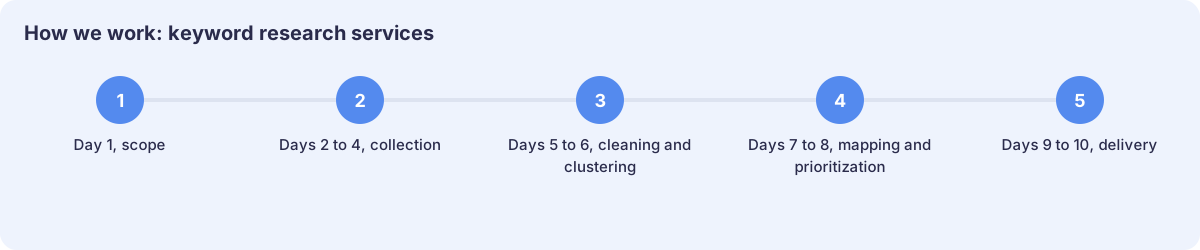
Ten working days for one country and one language. Each additional country adds about three days. Everything is written; there are no mandatory calls.
What you receive
A spreadsheet with one row per cluster: the main keyword, all secondary keywords, monthly search volume by country, average CPC, intent, difficulty estimate, the assigned URL (existing or new), a draft title and H1, and the priority rank. A second sheet lists the current site’s cannibalization conflicts and what to do with each. A memo of one to two pages explains the top 20 priorities in plain language.
If the next step is writing, the same document is the brief for SEO content and on-page optimization. The construction company case shows what a map turns into over time: 40 keywords in the top 10 and 13 times more clicks after 12 months (case study). The pages, the links and the time did the work there; the keyword research decided where that work went.
Pricing: how keyword research is priced
Keyword research is priced by scope: the number of countries and languages and the size of the site, quoted in writing after we see it. There is no percentage of revenue and no long contract.
For most clients the research is not bought on its own. It is the first month of the SEO care plans for small businesses ($350, $600 and $1,200 a month in the US, no contract) and of the B2B and SaaS programs for Europe (from €1,500 a month), where it feeds directly into pages, link building and reporting. A standalone map makes sense when you have your own writers or an in-house content team and just need the plan. A fixed-price SEO audit ($149 per page or $399 for a full site in the US, 48 hours) is a cheaper first step if you want to know whether the current pages target the right keywords before commissioning a full map.
Who it is for, and who it is not for
It is for a company entering a new country or language and building pages from zero; for a website with 50 or more pages that has never had a map and suspects cannibalization; for an in-house marketing team that can write and build but needs the plan; and for an online store deciding which categories to create. E-commerce keyword research has its own rules for categories and filters, described under SEO for e-commerce.
It is not for a five-page site with one service in one city: there the map is an hour of work inside an audit, and paying for a full research project is a waste. It is not for a business that wants a list of keywords «to put into the meta keywords tag», which Google has ignored for years. And it is not a ranking guarantee; a map says where the demand is, and the pages, links and time do the rest.
Frequently asked questions about keyword research services
Do you use Google Keyword Planner or paid keyword research tools?
Both. Keyword Planner gives volumes and CPC by country and is the base; it is still the best free keyword research tool for that job. Ahrefs or Semrush add competitor keywords and difficulty estimates. Clustering runs on our own parser of Google results, because no keyword tool clusters by the real top 10 of your country out of the box.
Can I do free keyword research myself?
Yes, for collection. Keyword Planner, Search Console, Google Trends and autocomplete are free and give you the raw list. The part that takes experience is clustering by SERP overlap and deciding which cluster gets which page. If you have the time, we can review your map instead of building one.
How many keywords will I get?
That is the wrong question, honestly. A raw list of 5,000 keywords is easy; a plan of 200 clusters you can execute is the point. The number of clusters depends on the niche and the country and is agreed before the work starts.
What is keyword management and do you offer it?
Keyword management is keeping the map alive: adding new keywords from Search Console every month, re-checking clusters when Google changes the results, retiring dead keywords and moving pages when priorities shift. It is part of the monthly plans and is not sold separately.
Does search volume still matter with AI answers in Google?
Volume still tells you where the demand is; AI Overviews change how much of that demand clicks through. In the score, informational clusters that Google now answers directly get a lower weight, and commercial clusters keep theirs. Getting cited in AI answers is a separate service, described under LLM SEO.
How often should keyword research be redone?
A full map lasts a year or two if the business does not change. A refresh from Search Console data every month is enough in between, which is what the monthly plans do. A new country or a new product line means new keyword research for that part of the site.
Send the site and the target countries to info@development-web.com and you will get a written scope and quote within one working day. If you are not sure the current pages are on the right keywords, start with a page audit; it is cheaper and often answers the question.
More SEO services
- SEO services
- SEO audit
- SEO consulting
- Technical SEO
- On-page SEO
- Off-page SEO
- Link building
- Local SEO
- SEO copywriting
- Content marketing
- International SEO
- Ecommerce SEO
- Amazon SEO
- Marketplace SEO
- Mobile SEO Services for Sites That Lose Rankings on Phones
- App Store Optimization Services for Apps That Need Organic Installs
- LLM SEO
- Monthly SEO plans
- SEO migration
- SEO for law firms
- Dental SEO
- Shopify SEO
- B2B SaaS SEO
- LegalTech SEO
- Small business SEO
- Healthcare SEO
- Real estate SEO
 Download brief
 Print brief