Mon–Fri: 10:00 – 18:00
 Request a call


On-page SEO services change what is on the page itself so that Google can match it to a query: the title tag, the H1, the headings, the text, the internal links and the schema markup. Global One Digital does this work by measurement rather than opinion. Each page is compared with the ten pages that already rank for its target keyword, and the gap between them becomes the list of edits.

Here is what that comparison looks like on a typical service page. The page has a few hundred words and targets a query where every ranking page runs past a thousand and shares dozens of terms your page never uses. No amount of technical polish will move it. It needs the sections the competitors have, the terms the competitors use, and a title that puts the query first. That is the work described on this page. Crawling, page speed and indexing problems are a different job, covered under technical SEO.
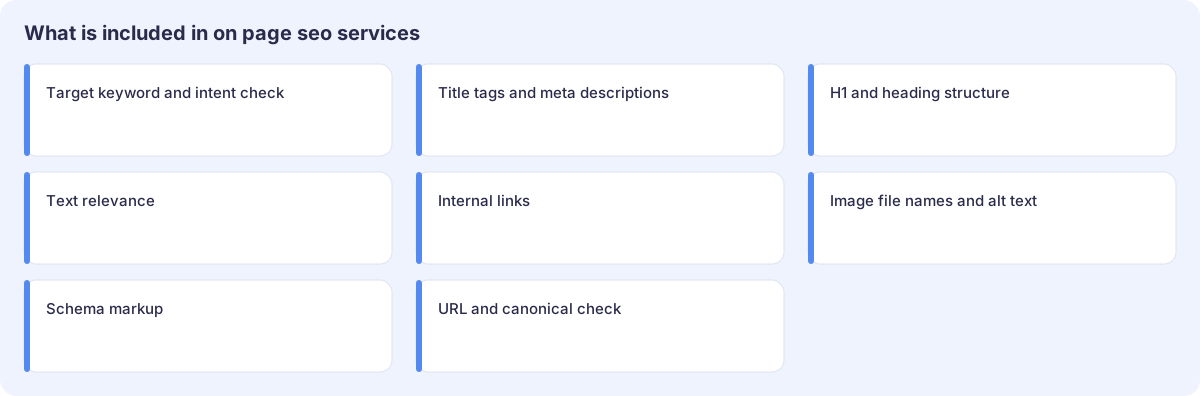
What our on-page SEO services include
Every engagement starts with a written audit of the pages in scope, then moves to edits. The list below is what gets checked and changed on each page.
- Target keyword and intent check. Each page gets one main query and a cluster of related keywords from Keyword Planner and Search Console. If two pages target the same query, one is merged or given a different query, because Google will otherwise split the ranking between them.
- Title tags and meta descriptions. The query goes first in the title, the title stays within 60 characters, and the description is written to earn the click in search results rather than to repeat keywords. Pages with impressions but low CTR in Search Console get priority.
- H1 and heading structure. One H1 per page containing the query, H2s that cover the sections the top 10 cover, no skipped levels. Headings are the part of the page search engines weigh most after the title.
- Text relevance. Word count, term coverage (width) and repetition of the main query (depth) measured against the top 10. The page is expanded or trimmed toward the median, and missing terms are worked into sentences, never listed.
- Internal links. Links from related pages with descriptive anchor text, links out to the pages that should rank next, and removal of orphan pages. On most sites this is the cheapest gain available.
- Image file names and alt text. Descriptive names, alt text that includes the query once, and sizes that do not slow the page.
- Schema markup. FAQPage, Service, Article, BreadcrumbList and LocalBusiness where the content supports it, validated after publishing.
- URL and canonical check. The slug stays as it is on any page that already ranks, because changing URLs loses accumulated signals. Canonical tags are checked for duplicates and pagination.
How we measure text relevance against the top 10
Most on-page SEO agencies work from a checklist. We work from a comparison. Our parser pulls the top 10 Google results for the target keyword in the target country, strips the templates, and measures each ranking page: total words, headings, the terms they share, and how often each uses the main query. That gives two numbers for your page.
Width is coverage: how many of the terms used by more than half of the ranking pages appear on yours at least once. A page at 40 percent width is missing the vocabulary Google associates with the topic. Depth is repetition: how many times the main query appears compared with the median of the top 10. Too little and the page reads as off-topic, too much and it reads as spam. The edit list follows from the numbers. Remove overuse first, add missing terms second, then adjust repetition to the median.
You can run the same check yourself with our free page analyzer. It shows word count, headings and keyword density for any URL, which is enough to see whether a page is in the range of its competitors before you pay anyone to rewrite it.
On-page SEO, technical SEO and off-page SEO: what belongs where
The three are often sold together, and they should be planned together, but they are different jobs with different people doing them. On-page SEO is content and structure: what a page says, how it is headed, where it links. Technical SEO is whether Google can crawl and render the page at all: indexing, redirects, site speed, mobile rendering, duplicate content from filters. Off-page SEO is everything that happens on other websites: backlinks, citations, reviews, brand mentions.
A page with perfect text that is blocked in robots.txt ranks nowhere, and a page that loads in half a second with 200 words ranks behind the one with 1,500. If you are not sure which problem you have, the SEO audit looks at all three and says which to fix first. If the gap is outside the site, see off-page SEO and, for links specifically, link building.
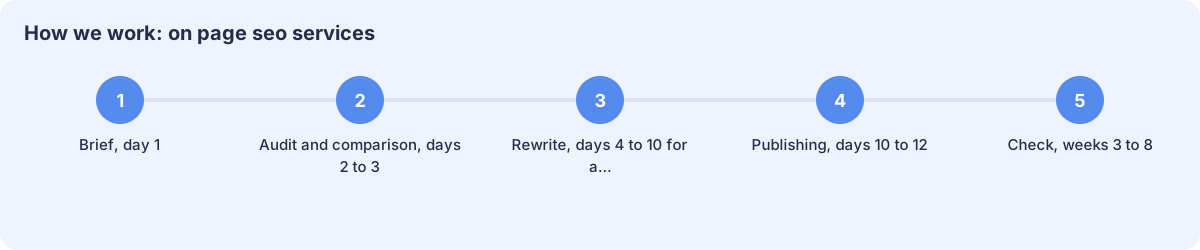
How we work
- Brief, day 1. You send the URLs to optimize, the target country, and read-only access to Google Search Console. If you do not have a keyword list, we build one from Search Console queries and Keyword Planner.
- Audit and comparison, days 2 to 3. Each page is measured against its top 10. You receive a written report per page: current title and headings, width and depth scores, missing terms, missing sections, internal link recommendations, schema to add.
- Rewrite, days 4 to 10 for a batch of 5 to 10 pages. New titles, H1s, headings and text, written by a native English or Russian editor and then re-measured. Other languages go through a native editor we bring in.
- Publishing, days 10 to 12. Either your team publishes from the document, or we publish through your CMS with access you grant. Schema is validated after publishing.
- Check, weeks 3 to 8. Impressions, average position and CTR per page in Search Console, compared with the four weeks before the change. Pages that did not move get a second pass.
Communication is by email or WhatsApp. There are no mandatory calls, and every recommendation exists as a document you can hand to a writer or developer later.
Ready to win Google traffic?
Free 30-minute strategy call. We will tell you what is realistic for your niche, your budget and your timeline — before quoting any work.
Common on-page SEO mistakes we fix
The same on-page SEO problems come up on most sites we audit, whatever the industry.
- The brand name is first in every title, so the query sits at the end where it carries the least weight.
- Three or four pages target the same keyword: a service page, a blog post, a category and a landing page from a past campaign. Google rotates between them and none holds a position.
- The page has 300 words on a query where the top 10 have 1,500. The text is fine; there is just not enough of it.
- Headings are design labels («Our approach», «Why us») rather than the sections a searcher expects to find.
- Internal links all say «read more» or «click here», and the pages that should rank have two links pointing at them.
- The main query appears in every second sentence. Density well above the top 10 median is treated as spam, and the page slides.
- Schema was added by a plugin and marks every page as an Article, including the pricing page.
Pricing for on-page SEO
The starting point is the fixed-price SEO audit: a single page audit or a full site audit, delivered in writing within 48 hours, with the price shown for your country (in the US, $149 for a page and $399 for a site). The audit report is the edit list; you can implement it yourself or ask for a quote on the rewrite.
Ongoing on-page SEO work for small businesses is part of the monthly SEO care plans, where a set number of pages is optimized each month with no contract term. B2B and SaaS companies in Europe get a program quote from the pricing page. Larger batches, such as the category tree of an online store, are quoted per batch after a written brief. Prices are fixed and do not depend on your revenue.
Who on-page SEO services are for
On-page SEO services fit sites that already have traffic and a working technical base but sit on positions 5 to 30 for the queries that matter. That is the range where text relevance is usually the deciding factor. It fits small businesses with 10 to 50 service pages, B2B and SaaS sites with feature and comparison pages, online stores with category pages that need text, and digital marketing agencies that want the measurement layer for their clients’ pages.
It is a poor fit for a site with no indexed pages, a site under a manual action, or a new domain with no history. Those need technical work or time before on-page edits show anything. It is also the wrong purchase if the site needs a hundred new pages rather than fixes to existing ones; that is a content marketing program.
What the numbers look like
An online store that scaled its content with us reached 320,580 impressions and 5,993 clicks in a single quarter (case study). A cleaning company with a handful of service pages went from 8 to 199 clicks a month, 25 times more, and holds top-3 positions on its main local queries (case study). Both are on-page work at different scales, and both are reported with Search Console data rather than tool scores.
Frequently asked questions about on-page SEO
What is on-page SEO, in one sentence?
Everything you change on the page itself to make it rank: title, headings, text, internal links, images and schema. It is the part of search engine optimization that you fully control, which is why it is usually the first thing to fix.
How is this different from technical SEO?
Technical SEO makes sure Google can reach and render the page: crawling, indexing, redirects, speed, mobile. On-page SEO makes sure the page deserves to rank once Google reaches it. We sell them separately because they need different skills and are often done by different people on your side.
How long does on-page SEO take to show results?
Title and heading changes are usually re-crawled within days and can move a page within two to four weeks. Text expansion takes longer, typically six to ten weeks for a settled position. We compare the eight weeks after the change with the four weeks before it in Search Console.
Do you use AI to write the content?
Drafting tools are used for structure and term coverage; the final text is written and edited by a person, and every page is measured after editing. Unedited generated text tends to repeat itself and misses the concrete details that make a page useful, and Google’s helpful content system has been demoting exactly that since 2022.
Can we do on-page SEO ourselves from your audit?
Yes, and many clients do. The audit report lists the exact title, headings, missing terms and links per page. If your writer can follow a brief, the rewrite is a day of work per page, and the free analyzer lets you re-check the page afterwards.
Does on-page SEO help with AI Overviews and ChatGPT answers?
Partly. AI answers pull from pages with clear headings, a direct answer in the first paragraph, and structured data, which is the same work. The extra steps for visibility in AI answers are described under LLM SEO.
How many pages should we start with?
Ten. Take the pages that already rank between positions 5 and 30 in Search Console for queries with real search volume. Those move fastest and prove the method before you commit to the whole site.
Send your URLs and target country to info@development-web.com for a fixed quote, or order a written on-page audit and have the edit list in 48 hours.
More SEO services
- SEO services
- SEO audit
- SEO consulting
- Technical SEO
- Off-page SEO
- Link building
- Local SEO
- SEO copywriting
- Keyword research
- Content marketing
- International SEO
- Ecommerce SEO
- Amazon SEO
- Marketplace SEO
- Mobile SEO Services for Sites That Lose Rankings on Phones
- App Store Optimization Services for Apps That Need Organic Installs
- LLM SEO
- Monthly SEO plans
- SEO migration
- SEO for law firms
- Dental SEO
- Shopify SEO
- B2B SaaS SEO
- LegalTech SEO
- Small business SEO
- Healthcare SEO
- Real estate SEO
 Download brief
 Print brief