Mon–Fri: 10:00 – 18:00
 Request a call



Mobile SEO services fix one specific problem: Google ranks the version of your site that a phone sees, and that version is often slower and thinner than the desktop version your team looks at. Since Google completed the move to mobile-first indexing, the smartphone crawler is the only one that matters for most sites. If the mobile page hides a paragraph behind a tab, loads a 3 MB hero image or puts two links four pixels apart, that is the page being ranked. Global One Digital audits and fixes the mobile slice of your site’s SEO: indexing parity, Core Web Vitals measured on mobile networks, tap targets and accessibility, and the local queries that come from phones.

How mobile SEO differs from technical SEO
Our technical SEO service covers the whole site: crawl budget, redirects, canonicals, structured data, server response times. Mobile SEO is the narrower question of what Googlebot Smartphone sees and what a person on a 4G connection in a train actually experiences. Plenty of sites pass a desktop audit and fail on a phone. The navigation is collapsed into JavaScript that never renders for the crawler. The product description sits behind a «read more» that loads on tap. A cookie pop-up covers the content on first paint. You can order mobile SEO on its own or as a section of the technical audit; the checks are the same either way.
Mobile-first indexing and content parity
Mobile-first indexing means Google uses the mobile version of a page for indexing and ranking. The usual failure is a parity gap: the mobile template drops text, internal links, image alt attributes or structured data that the desktop template has. From the crawler’s point of view that content does not exist.
The parity check compares the rendered mobile and desktop HTML of each template: word count, headings, number of internal links, presence of schema, canonical and hreflang tags. Every difference goes into a list with a fix next to it. Typical findings are a mobile menu with 12 links where desktop has 60, accordion content that is only loaded on click, and «lite» pages on a separate m-dot subdomain that Google indexes instead of the full page. Separate mobile URLs still work, but they double the maintenance. Responsive design serving the same HTML to both is almost always the cheaper fix.
Core Web Vitals on real mobile networks
Google reports Core Web Vitals separately for mobile and desktop, and it is the mobile numbers that fail. The thresholds are public: Largest Contentful Paint under 2.5 seconds, Interaction to Next Paint under 200 milliseconds, Cumulative Layout Shift under 0.1, each measured at the 75th percentile of real visits. A page that feels instant on office Wi-Fi can miss all three on a mid-range Android phone over 4G.
We start from field data in Search Console and the Chrome UX Report, then reproduce the problem in lab tests with CPU throttling and slow network profiles. The fixes are usually unglamorous: hero images sized for the viewport in WebP or AVIF, fonts that do not block rendering, third party scripts loaded after the first interaction, fixed dimensions for ads and embeds so the layout stops jumping. On WordPress sites we do most of this ourselves. On custom stacks your developers get a numbered list with the expected gain per item, and we re-test after each deploy.
Tap targets, readability and the European Accessibility Act
Some interface details never show up in a desktop audit. Links closer together than a fingertip. Body text below 16 px that forces people to zoom. Form fields that open the wrong keyboard. A sticky header that eats a third of the screen. Google’s own testing tools flag tap targets smaller than roughly 48 by 48 CSS pixels, and users simply leave before any ranking factor gets a chance to matter.
Since June 28, 2025 the European Accessibility Act applies to e-commerce and many online services sold to consumers in the EU, with WCAG 2.1 AA as the working standard. That standard overlaps almost entirely with good mobile SEO: contrast, visible focus states, labeled form fields, content readable without zoom, no interstitials that trap a keyboard or screen reader user. If you sell into the EU, the mobile audit includes an accessibility pass listing the specific WCAG criteria you fail, so one round of fixes covers both the ranking side and the legal side.
Ready to win Google traffic?
Free 30-minute strategy call. We will tell you what is realistic for your niche, your budget and your timeline — before quoting any work.
Local searches from a phone
«Near me», «open now», a business category plus a district name: these queries are mostly typed or spoken into phones, and Google answers them with the map pack before the organic results. Mobile SEO for a local business therefore includes the Google Business Profile, tap-to-call links, opening hours in structured data and a page that loads fast enough for someone standing on the street. A cleaning company in Tbilisi that went from 8 to 199 clicks a month ranks in the top three for exactly this kind of query; the details are in the case study. The full local package is a separate service, local SEO, and the two are often ordered together.
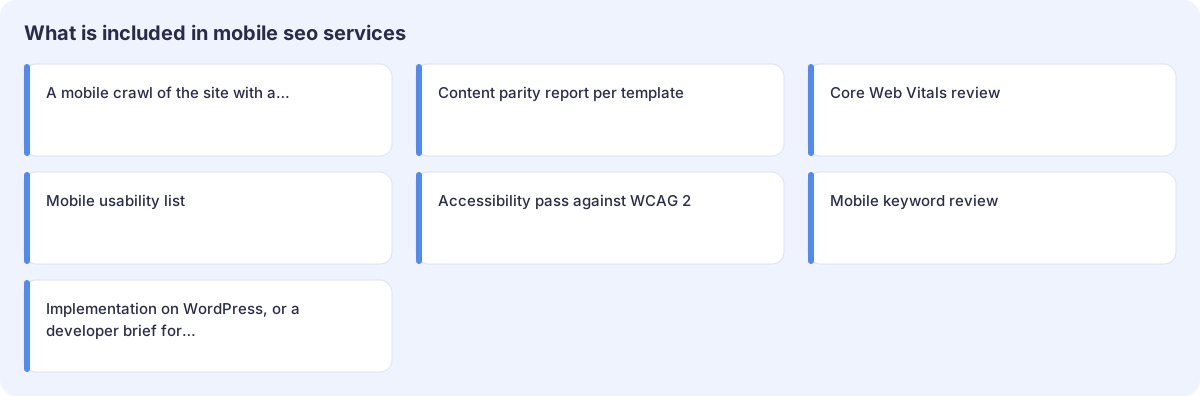
What is included in mobile SEO services
- A mobile crawl of the site with a smartphone user agent and JavaScript rendered, compared against the desktop crawl. Our crawler runs about 90 checks per page.
- Content parity report per template: text, links, headings, images, schema, meta tags, hreflang.
- Core Web Vitals review: field data by page group from Search Console, lab reproduction, prioritized fixes with the expected effect of each.
- Mobile usability list: tap targets, font sizes, viewport settings, interstitials, sticky elements, form behavior.
- Accessibility pass against WCAG 2.1 AA for EU-facing sites, mapped to the EAA.
- Mobile keyword review: queries where your mobile position in Search Console differs from desktop, and which pages to fix first.
- Implementation on WordPress, or a developer brief for other platforms, plus a re-check after deployment.
Two things sit outside this service. We do not build native apps on this page; that is mobile app development. And ranking inside the App Store or Google Play is a different discipline covered by app store optimization. Mobile SEO is about your website as seen from a phone.
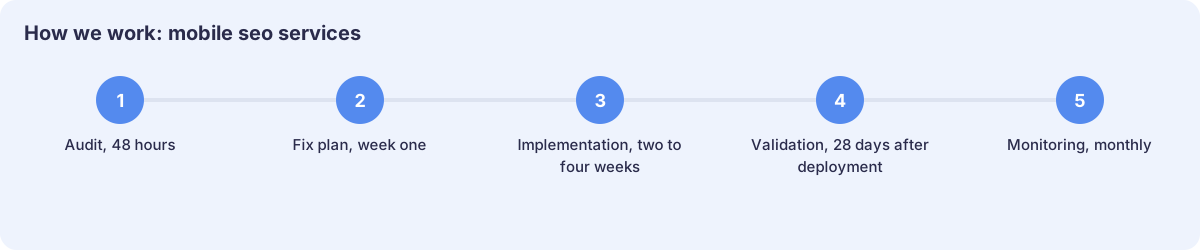
How we work
- Audit, 48 hours. You send the domain and Search Console access. You receive a written document: parity gaps by template, Core Web Vitals status by page group, usability and accessibility findings, all sorted by expected impact. Everything is done by email or WhatsApp.
- Fix plan, week one. The findings become a task list with an owner for each item: us on WordPress, your developers elsewhere. You approve the order of work in writing.
- Implementation, two to four weeks. Image pipeline, script loading, template changes, form fixes. Each change is tested on a throttled mobile profile and on an actual phone before it ships.
- Validation, 28 days after deployment. Field data in Search Console updates on a 28-day window, so Core Web Vitals are re-checked then and the parity fixes are confirmed in the indexed version of each page.
- Monitoring, monthly. New templates, new plugins and new ad scripts break mobile pages regularly. The monthly mobile SEO report shows what moved, what broke and what to do next.
Pricing
Mobile SEO starts with the fixed-price SEO audit: a single page for $149 or the full site for $399 in the US, with prices for other countries shown on the page, delivered in writing within 48 hours. If you want us to implement and keep watching, the work runs under a monthly care plan, $350 to $1,200 a month in the US depending on site size, with no contract. B2B and SaaS companies in Europe with larger sites are usually served through the program pricing from €1,500 a month. Every plan is a flat monthly rate; nothing is tied to a percentage of revenue, and you can stop at the end of any month.
Who this is for, and who should look elsewhere
Mobile SEO services make sense for e-commerce and service sites where Search Console shows most impressions coming from mobile and Core Web Vitals sitting in the «poor» or «needs improvement» bucket. Companies selling into the EU that need the accessibility pass anyway. Local businesses whose customers search from the street. Sites that were redesigned recently and lost rankings afterwards; a migration done carefully keeps them, and the same checks apply after the fact.
Not for: sites whose mobile pages are already green in Search Console and identical to desktop, where the budget does more in content or links. Not for app publishers who need installs rather than website visits. And not for anyone hoping a faster page alone will lift rankings on a site with no content worth ranking; speed removes a penalty, it does not create relevance.
Frequently asked questions about mobile SEO
What is mobile SEO, in plain terms?
It is making sure the phone version of your site contains everything the desktop version has, loads fast on a real mobile network, and can be used with a thumb. Google ranks that version, so any gap between the two costs you positions.
Does Google still look at the desktop version of my site?
For almost all sites, no. Google crawls and indexes with the smartphone user agent, and the desktop crawler is used mostly for verification. If your desktop page has content the mobile page lacks, that content is effectively invisible.
My site is responsive. Do I still need mobile SEO services?
Responsive design solves the parity problem in principle, but themes and plugins often hide elements with CSS on small screens, load different images, or defer content in ways that still fail the crawler. Responsive sites also carry the full desktop weight to the phone, which is where the Core Web Vitals problems come from. The audit will tell you quickly whether there is anything to fix.
How fast does a mobile page have to be?
Fast enough for 75 percent of real visitors to see the main content within 2.5 seconds, respond to taps within 200 milliseconds and not have the layout jump more than a CLS of 0.1. Those are Google’s published thresholds. Lab scores are a diagnostic tool; field data is what counts.
Is AMP still worth building?
Not for new projects. Google dropped the AMP requirement for Top Stories in 2021, and a well-built responsive page passes Core Web Vitals without a second codebase. If you already run AMP pages, we check whether removing them is safe before recommending it.
Do you test on real devices or emulators?
Both. Lab runs with throttled CPU and network catch the measurable issues, and field data from the Chrome UX Report shows what real visitors get. We also open the pages on actual phones, because emulators miss things like keyboard behavior and sticky elements covering buttons.
Does the European Accessibility Act apply to my site?
If you sell products or services to consumers in the EU, most likely yes, with some exemptions for very small companies. We are not lawyers and will not give a legal opinion, but we map your mobile pages to WCAG 2.1 AA and list the failures, which is what any compliance review starts with.
The fastest way to find out how your site looks to Google’s phone crawler is a written audit, delivered within 48 hours. Or send the URL to info@development-web.com with one line about what you have noticed, and we will reply with what to check first.
More SEO services
- SEO services
- SEO audit
- SEO consulting
- Technical SEO
- On-page SEO
- Off-page SEO
- Link building
- Local SEO
- SEO copywriting
- Keyword research
- Content marketing
- International SEO
- Ecommerce SEO
- Amazon SEO
- Marketplace SEO
- App Store Optimization Services for Apps That Need Organic Installs
- LLM SEO
- Monthly SEO plans
- SEO migration
- SEO for law firms
- Dental SEO
- Shopify SEO
- B2B SaaS SEO
- LegalTech SEO
- Small business SEO
- Healthcare SEO
- Real estate SEO
 Download brief
 Print brief