Mon–Fri: 10:00 – 18:00
  Request a call



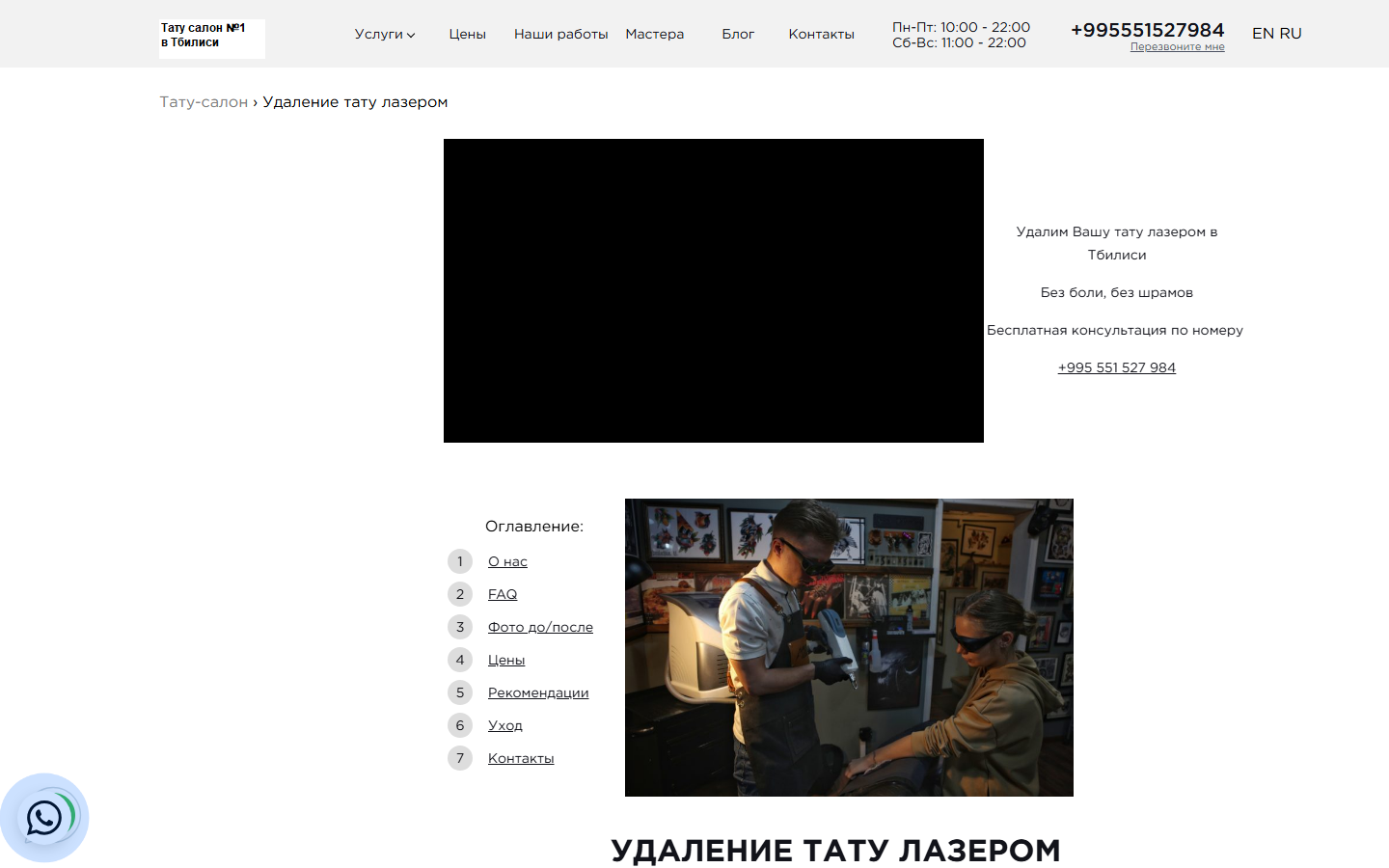
The brief. A Tbilisi tattoo studio grew from a single location into an international multilingual network and was moving to a new site structure (studio-tattoo.com, EN + RU). The risk in any move like this is the usual one: losing the rankings built up over years. The studio already had Russian-language organic traffic from Georgia, Russia, Ukraine and Israel that could not be lost. Our job was to migrate the site so rankings held — and the structure could carry the expansion into new cities and a second language.
What we did in the migration
We ran the move as a checklist, not a hope — the same method as any SEO migration:
- A full URL map with single 301 redirects from old to new addresses — no chains, no dead ends.
- hreflang between the RU and EN versions so Google never confuses the languages or cannibalises pages.
- On-page parity: titles, meta, internal links and schema carried across, not dropped in the move.
- Content built around real demand — laser tattoo removal, services (piercing, permanent makeup), a blog answering client questions.
- Search Console monitoring through the first weeks, when volatility is highest and fast fixes matter.
Results (Google Search Console data)
September 2025 → October 2026, all verifiable:
| Metric | Start, Sep 2025 | Now, Sep 2026 |
|---|---|---|
| Monthly impressions | ~794 | 11,593 (14.6×) |
| Queries with impressions | — | 1,313 |
| Queries in the top 10 | — | 153 |
| Queries in the top 3 | — | 20 |
| Rankings lost in migration | none — visibility grew rather than dropped | |
A year on, not everything moved up, and that is worth saying plainly. Impressions tripled against the previous snapshot and the query count doubled. Meanwhile part of the old core slipped: «тату тбилиси» from 6.4 to 7.9, «тату салон тбилиси» from 6.9 to 8.4, and two arm-tattoo queries almost stopped appearing. One improved: «удаление тату тбилиси», the studio’s main commercial query, went from 4.9 to 3.5.
This is what growing reach looks like. The site now catches many times more queries, and an average over five hand-picked ones stops describing the whole. Hence the aggregates in the table above rather than a selection.
Why the migration kept every ranking
Most post-migration drops come from small things: missing 301s, lost metadata, orphaned pages, changed URLs with no map. We closed each one before launch and watched indexation after. So instead of the typical 30-60% traffic drop, the site preserved its accumulated authority and kept growing on the new structure.
FAQ
Will the site lose rankings during migration?
With a proper migration, no. A short dip in the first weeks is normal; the large, lasting drops come only from mistakes — broken redirects, lost metadata — which the URL map prevents.
How do you handle the multilingual side (RU + EN)?
Languages are separated with hreflang, each with its own content rather than a translation. Google serves the right version per user language and the pages do not compete.
How long does a migration like this take?
Plan and URL map: 1-2 weeks. Monitoring: the first 4-6 weeks after launch. After that the site grows on its preserved authority.
Similar challenge? See our SEO migration service, an SEO audit, or other case studies.
 Download brief
  Print brief