Mon–Fri: 10:00 – 18:00
 Request a call


Amazon ranks a product on two things: whether the listing matches the search terms a shopper typed, and whether shoppers who saw it went on to buy. Amazon SEO services deal with the first directly and the second indirectly: keyword research for the Amazon search box, listing optimization (title, bullet points, description, backend search terms, A+ content, images), a working process for reviews and rating, and external traffic from Google to your product listings. Global One Digital does this for brands from Europe and the CIS that are launching on Amazon US, UK and the EU marketplaces, in English and Russian, with native editors for German, French, Italian and Spanish listings.

Two things upfront. Amazon Ads, Brand Analytics and Seller Central stay on your account; we work inside them with user permissions, and nothing runs through an agency account. And there is no sales guarantee: rankings on Amazon depend on price, stock, reviews and competition as much as on the listing, and anyone promising a number is guessing.
What Amazon SEO is, and how it differs from Google SEO
Google ranks pages on relevance, links and how users behave. Amazon ranks listings on relevance to the search term and on sales performance: conversion rate, sales velocity, price, availability, reviews. There is no link building. A listing that converts poorly sinks even with perfect keywords, and a listing that sells fast rises even with a mediocre title, for a while.
This changes what «optimization» means. On Google, a page can rank on text alone for months. On Amazon, the text gets your product indexed for the right search terms and shown in search results; the price, images, reviews and stock decide whether it stays there. So Amazon SEO is half text and half operating discipline, and the second half needs the seller as much as the agency.
Amazon’s AI shopping assistant, Rufus, now answers customer questions from the title, bullets, description and Q&A of a listing. A listing written as a keyword string gives Rufus nothing to say; a listing written as clear product facts gets used.
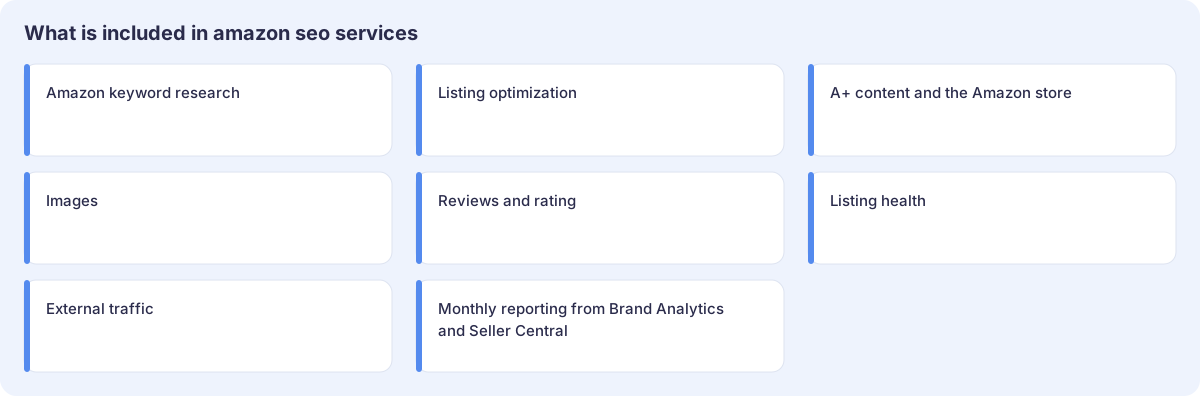
What is included in our Amazon SEO services
- Amazon keyword research: search terms from Amazon autocomplete, the Search Query Performance dashboard in Brand Analytics (on your account), search term reports from your Sponsored Products campaigns, and the terms competitor listings are indexed for. Sorted by relevance to the product first, volume second.
- Listing optimization: product titles within Amazon’s 200-character limit, five bullet points written as benefits with search terms placed naturally, a description that reads as product information, and backend search terms filling the 250-byte limit without repeating the title.
- A+ content and the Amazon store: module structure, comparison charts, image text that reinforces the main terms. Both require Brand Registry; we help with the application if your brand is not enrolled.
- Images: a brief for the main image and the secondary slots (infographics, size, use context, packaging), because images decide click-through and conversion, and conversion feeds ranking.
- Reviews and rating: Vine enrollment for new ASINs, the Request a Review button used on schedule, inserts that stay inside Amazon’s terms, and a process for answering questions and negative reviews within 24 hours.
- Listing health: suppressed listings, missing attributes, wrong browse node, variation families that split reviews, and category requirements that keep a product out of search.
- External traffic: pages on your own site and articles that rank in Google for the product terms and send shoppers to the listing, tracked with Amazon Attribution and partly paid back through the Brand Referral Bonus.
- Monthly reporting from Brand Analytics and Seller Central: search term rankings, impressions, click share, conversion by ASIN, review count and rating, in a written report you can check against your own dashboard.
Not included: full-service PPC management, logistics, VAT and EPR registration, and account reinstatement.
Listing optimization, item by item
Product titles
The title is the strongest relevance signal and the first thing a shopper reads in search results. It gets your brand, the product type, the two or three highest-volume search terms and the defining attributes (size, count, material), in a readable order, under the limit for the category. Repeating a word more than twice or stuffing in «best» and «premium» breaks Amazon’s title policy; since January 2025 Amazon enforces it and may rewrite a non-compliant title on its own.
Bullet points
Five bullets, each answering one question a customer has before buying: what it does, who it fits, what is in the box, how it compares, what happens if it does not fit. Search terms go inside those sentences. The bullets carry the terms the title could not hold.
Backend search terms
The hidden field is for synonyms, spelling variants, regional wording (UK versus US), and terms in other languages shoppers use on the same marketplace. It is not for repeating the title or for competitor brand names. Amazon indexes 250 bytes; we fill them once, check indexing with a search of the ASIN plus the term, and revise monthly from the search term reports.
A+ content and images
A+ body text is generally not indexed for Amazon search, so its job is conversion: comparison charts against your own range, use cases, sizing. Image alt text in A+ modules is indexed, one of the few free places left to add a term. The main image follows Amazon’s white-background rules; the secondary images do the selling.
Google to Amazon: the part most Amazon SEO agencies skip
Amazon rewards sales that come from outside Amazon: the Brand Referral Bonus returns a share of the referral fee on those sales, and externally driven conversions count toward ranking like any other. Most Amazon SEO agencies come from the marketplace side and do not build the Google side. We come from the Google side, which is where most of our SEO work lives.
The practical setup: a product page or category page on your own website that ranks in Google for the product terms and links to the listing with an Amazon Attribution tag, plus a small set of articles for the informational queries around the product («how to choose», «size guide», comparisons). If the brand has no site yet, we build one (online store development). This is the same method as our e-commerce SEO work; the content-at-scale case (320,580 impressions and 5,993 clicks in a quarter, details here) shows the shape of the traffic such pages bring. For a brand that sells only on Amazon, this is usually the biggest growth lever left after the listings are fixed.
Ready to win Google traffic?
Free 30-minute strategy call. We will tell you what is realistic for your niche, your budget and your timeline — before quoting any work.
For brands entering Amazon US and EU from Europe and the CIS
The service is built for manufacturers and brand owners in Georgia, Turkey, the Baltics, Poland, Kazakhstan and similar markets that already sell at home and want Amazon US, UK or the EU marketplaces. The typical starting point is a listing translated from the home-market catalog, with search terms guessed rather than collected, no A+ content and three reviews. Working in Russian with the founder and in English with the marketplace is the normal mode; German, French, Italian and Spanish listings are written by native editors from our English brief, because a translated listing misses the terms local shoppers type.
Each marketplace is its own keyword research. The terms for a product on amazon.de are not the German translation of the amazon.com terms; they are whatever German shoppers type, collected from the German autocomplete and the German Brand Analytics data. It is the same discipline as international SEO on Google, with a different search box.
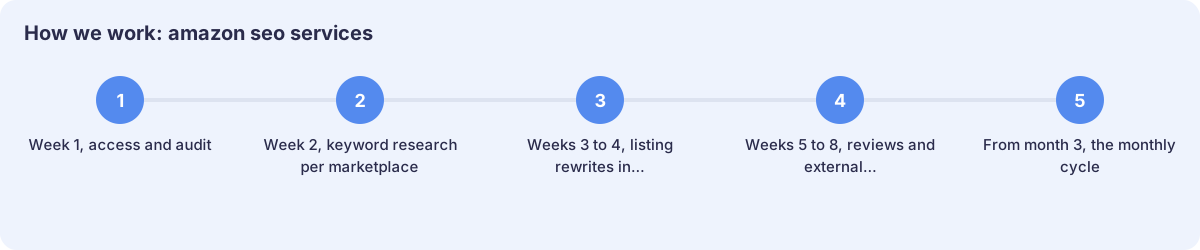
How we work: the first 60 days
- Week 1, access and audit. You add us as a user in Seller Central with permissions for listings, Brand Analytics and advertising reports. We audit every ASIN: indexing for the target terms, title and bullet compliance, image slots, A+ status, review count. The audit arrives in writing with a priority list.
- Week 2, keyword research per marketplace. Search terms collected from autocomplete, Brand Analytics, your ad reports and competitor listings; sorted by relevance and volume; assigned to title, bullets or backend for each ASIN.
- Weeks 3 to 4, listing rewrites in batches. Titles, bullets, descriptions and backend terms for the priority ASINs, sent to you for a fact check (materials, sizes, certifications), then uploaded by you or by us. Image and A+ briefs go to your designer at the same time.
- Weeks 5 to 8, reviews and external traffic. Vine enrollment for eligible ASINs, the review request schedule, and the first Google pages for the product terms.
- From month 3, the monthly cycle. Brand Analytics and search term reports are read each month, backend terms and bullets are revised, new ASINs get the same treatment, and the written report compares visibility, rankings and conversion with the previous month.
Everything is written, by email or WhatsApp. The timing assumes up to 30 ASINs on one marketplace; larger catalogs and additional marketplaces are scheduled in batches.
Pricing: how Amazon SEO is priced
A fixed monthly price, quoted in writing after the week-one audit, based on the number of ASINs and marketplaces. No percentage of sales and no long contract; the first month covers the audit and the keyword research, so if you stop there you still have a document you can use.
The Google side of the funnel is priced separately, through products with published prices. For a small brand, the SEO care plans ($350, $600 and $1,200 a month in the US, no contract) cover the product pages and articles on your own site that send traffic to the listing. The fixed-price SEO audit ($149 per page or $399 for a full site in the US, 48 hours) is the cheaper first step if you want your own site checked before starting on Amazon. Prices for Europe and the CIS are shown on those pages by country.
Who Amazon SEO is for, and who it is not for
It is for brand owners with their own product and margin who are launching on Amazon US or an EU marketplace, or who have been on Amazon for a year with listings nobody has touched since launch. It is for sellers with Brand Registry, or willing to get it, because A+ content, Vine, Brand Analytics and the Brand Referral Bonus all depend on it.
It is not for arbitrage or resellers of other brands’ products: you cannot edit the listing, so there is nothing to optimize. It is not for a product priced 30 percent above the competing listings; no title fixes that. It is not for anyone who wants a sales guarantee, and it is not a substitute for stock: a listing that runs out loses its ranking until the product is back.
Frequently asked questions about Amazon SEO
How long does Amazon SEO take to improve rankings?
Indexing for new backend terms shows within days. Ranking movement for the main search terms usually takes four to eight weeks after the rewrite, because it depends on conversions accumulating. Reviews and external traffic are slower, three months and more. A written report every month shows what moved.
What is the difference between front-end and backend keywords?
Front-end terms are in the title, bullets and description that shoppers read. Backend search terms sit in a hidden field of the listing, indexed but not displayed, for synonyms and variants that would make the visible text unreadable. Both count for indexing; only the front-end text affects conversion.
Do you manage Amazon PPC and marketing too?
We read your advertising reports for keyword data and can set up a basic Sponsored Products campaign to get a new ASIN its first sales, because early conversions feed organic ranking. Ongoing PPC management and Amazon marketing as a service are not something we sell.
Can we get reviews faster?
Inside Amazon’s rules: Vine for new ASINs, the Request a Review button, product inserts that ask for feedback without asking for a positive one. Buying reviews or offering refunds for reviews gets listings and accounts suspended, and we will not do it.
Do you have Amazon case studies?
Not published yet. The cases on this site are Google SEO, including e-commerce content at scale and a site migration without lost positions. The Amazon SEO strategy uses the same keyword and text discipline, and the first Amazon case will go up only with real Brand Analytics numbers and the client’s consent.
To start, send the storefront or ASIN list and the target marketplace to info@development-web.com. You will get a written reply within one working day with the scope of the week-one audit; the fixed monthly price for your Amazon SEO follows once the audit is done.
More SEO services
- SEO services
- SEO audit
- SEO consulting
- Technical SEO
- On-page SEO
- Off-page SEO
- Link building
- Local SEO
- SEO copywriting
- Keyword research
- Content marketing
- International SEO
- Ecommerce SEO
- Marketplace SEO
- Mobile SEO Services for Sites That Lose Rankings on Phones
- App Store Optimization Services for Apps That Need Organic Installs
- LLM SEO
- Monthly SEO plans
- SEO migration
- SEO for law firms
- Dental SEO
- Shopify SEO
- B2B SaaS SEO
- LegalTech SEO
- Small business SEO
- Healthcare SEO
- Real estate SEO
 Download brief
 Print brief