
 Mon–Fri: 10:00 – 18:00
  Request a call



AOV Calculator — Average Order Value + Revenue Lift
Average order value, revenue per visitor, conversion rate, and the revenue lift from raising AOV by X%. Use it to size the impact of upsells, bundles, or pricing changes before you ship them.
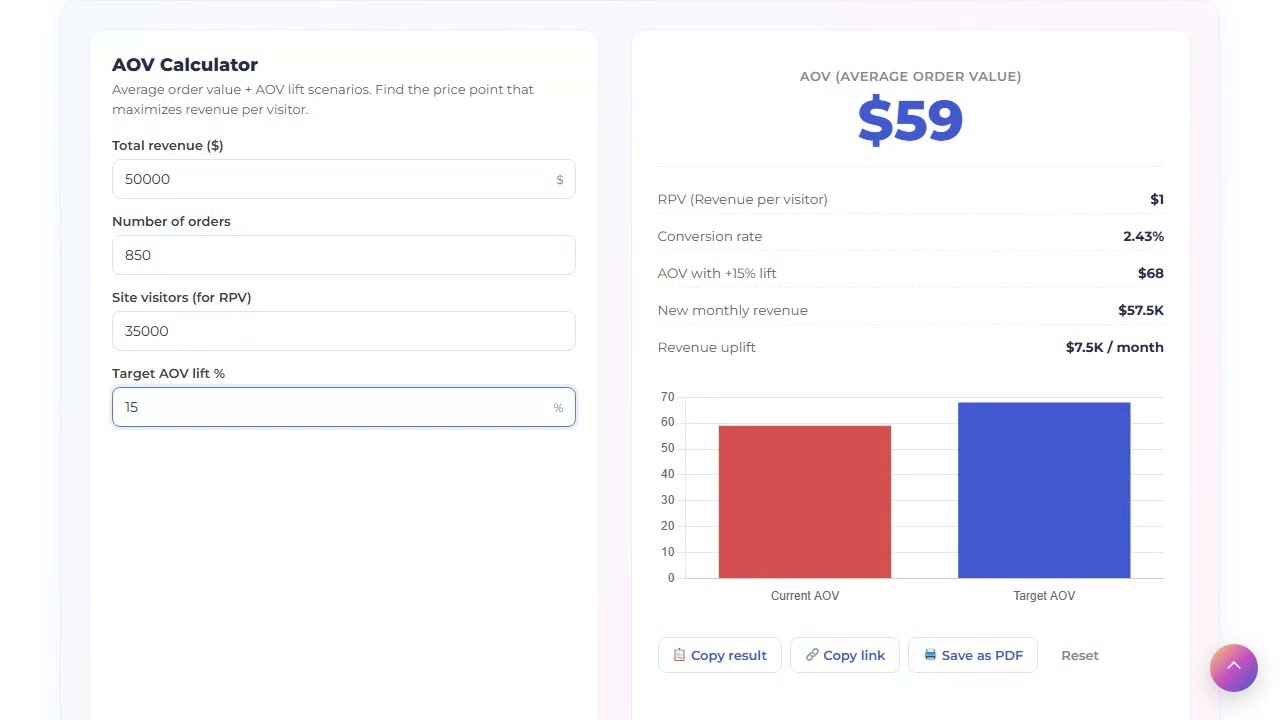
AOV — the most under-leveraged growth lever in e-commerce and SaaS
Average Order Value (AOV) is total revenue divided by number of orders. Most teams obsess over conversion rate while leaving AOV untouched — but a 20% AOV lift compounds with every channel, every campaign, forever. Conversion-rate optimization, by contrast, only lifts the slice of traffic that converts.
The formulas
AOV                  = revenue / number of orders
RPV                  = revenue / total visitors
conversion rate      = orders / visitors × 100%
new AOV with lift    = AOV × (1 + target lift %)
revenue uplift       = (new AOV × orders) − current revenue
Why AOV beats CR for compounding growth
RPV = AOV × conversion rate. A 10% lift in AOV produces the same RPV as a 10% lift in conversion rate — but AOV is usually easier to move (cross-sells, bundles, pricing tiers) than CR (which requires landing-page and funnel work). And AOV lift carries through every traffic source equally; CR lift only applies to the channel you tested.
Industry benchmarks (2026)
- B2C e-commerce (apparel): $60-150 AOV.
- B2C e-commerce (electronics): $150-500 AOV.
- B2C subscription (monthly): $15-50 AOV.
- B2B e-commerce / wholesale: $500-5,000+ AOV.
- B2B SaaS (annual contract): $5,000-50,000+ ACV (functional equivalent of AOV).
How to lift AOV (proven plays)
- Cross-sell at cart: "Frequently bought together" / "Complete the look" — adds 10-25% AOV on average.
- Bundle pricing: 3-for-$X type offers; especially effective for repeat-purchase categories.
- Free shipping threshold: set just above current AOV. Pushes customers to add one more item.
- Tiered pricing: for SaaS — middle tier engineered to be the obvious choice.
- Volume discounts: 10% off when buying 3+; encourages stocking up.
How to calculate AOV and size lift opportunities
Three numbers from analytics + a target lift. The calculator shows you exactly how much revenue is on the table.
Pull revenue + orders
From your store / billing system, last 30 days. Use net revenue (after refunds), not gross sales.
Pull visitor count
From GA4 or your analytics. Use unique visitors, not sessions, for cleaner RPV.
Set realistic target lift
15-30% is the typical range for an AOV optimization sprint with cross-sells + bundles + threshold tuning. Below 10% is barely worth testing; above 50% is unrealistic without a major catalog or pricing change.
Read the revenue uplift
Dollar uplift = (new AOV − current AOV) × current order count. This is the size of the opportunity. Compare to what the team would cost to ship.
Decide if the work is worth it
A $50k/month uplift opportunity justifies 2-3 months of optimization work. A $5k/month uplift does not.
Frequently asked questions about AOV
AOV = total revenue / number of orders. Use a consistent period (30 or 90 days), net revenue (after refunds), and unique orders (not order line items). For SaaS, the functional equivalent is ACV (annual contract value) — same math, different framing.
Depends on category. Apparel: $60-150. Electronics: $150-500. Home goods: $80-300. Beauty: $40-100. Compare your AOV against your direct competitors, not blanket industry averages — those are too broad.
AOV usually, because: (1) AOV lifts compound across all traffic channels, not just the one you tested; (2) AOV is typically easier to move (cross-sells, bundles, thresholds) than CR (which requires landing-page rebuilds); (3) AOV lift compounds with retention. Fix AOV first, then CR.
AOV = revenue / orders (cost per customer per transaction). RPV = revenue / visitors (revenue earned per visitor regardless of conversion). RPV = AOV × conversion rate. RPV is the true north-star for e-commerce because it captures both AOV and CR in one number.
Cross-sells at cart (10-25% lift), product bundles (10-30%), free shipping threshold set above current AOV (5-15%), tiered pricing for subscription (8-20%), volume discounts (5-12%). Combine 2-3 plays simultaneously for compounding effect.
Yes — when the threshold is set 15-25% above current AOV. Setting it at current AOV does little; setting it 50%+ above pushes customers to abandon. The sweet spot is "this much more and I get free shipping" — close enough to feel worth it.
Want help running an AOV-lift sprint?
See what is holding your own page back
Paste a URL and get about twenty checks on the live page — indexing, meta, headings, markup, speed. Every finding on screen, the fixes by email.