
 Mon–Fri: 10:00 – 18:00
  Request a call



CPC Calculator — Cost Per Click + CTR + CPA
Cost per click, click-through rate, conversions, and cost per acquisition in one panel. Use it to plan PPC budgets, compare channels, or pitch a CRO scenario to your team.
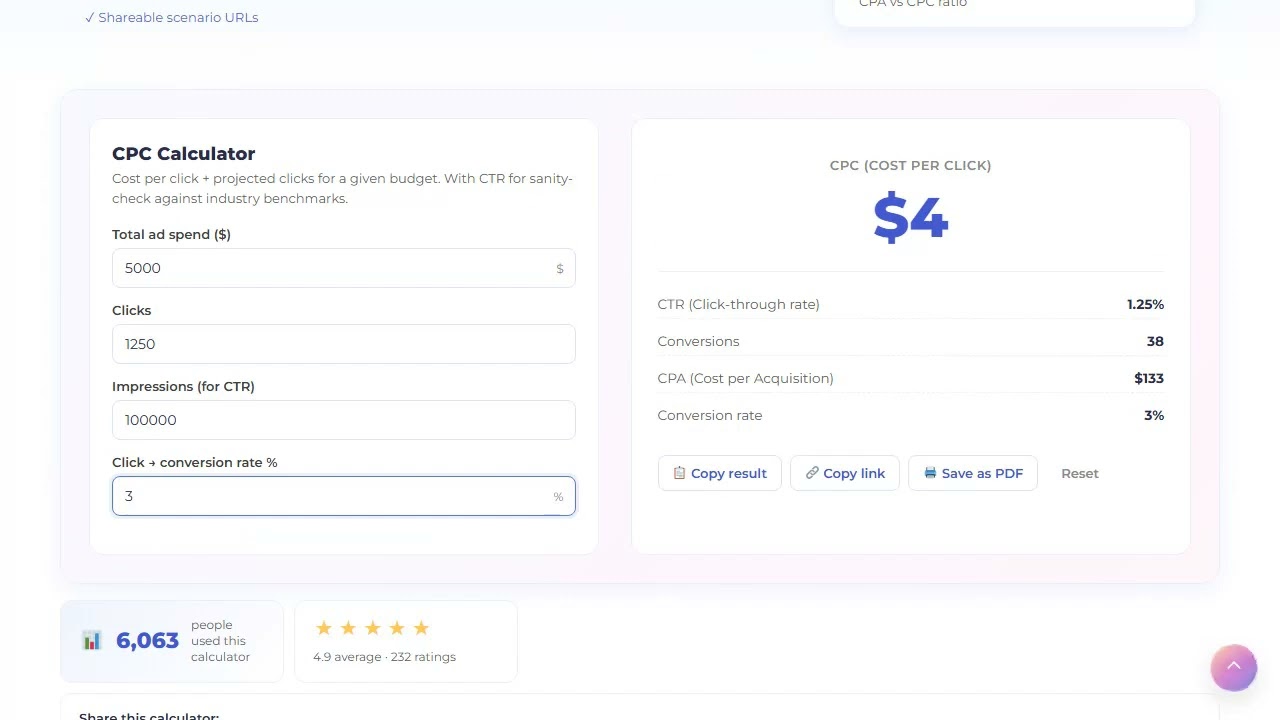
CPC, CTR, and CPA — the three numbers PPC actually runs on
CPC (Cost Per Click) is the price you pay each time someone clicks an ad. By itself, CPC is meaningless — a $0.50 click that never converts is worse than a $5 click that drives a sale. That is why this calculator surfaces CTR and CPA alongside CPC.
The formulas
CPC           = total spend / clicks
CTR           = clicks / impressions × 100%
conversions   = clicks × conversion rate
CPA           = total spend / conversions
What healthy numbers look like (2026 B2B SaaS)
- CTR: 2-5% on Google Search (branded 8-15%), 0.5-2% on display, 0.4-1% on LinkedIn sponsored content.
- CPC: $1-50 on Google Search depending on keyword competition, $3-15 on LinkedIn, $0.5-3 on Meta for B2B.
- Conversion rate: 1-5% click-to-lead on cold paid traffic, 5-15% on retargeting.
- CPA vs CPC ratio: Typically 3-10× — if your conversion rate is 20%, CPA = 5 × CPC; if conversion rate is 1%, CPA = 100 × CPC.
Common PPC mistakes the calculator surfaces
- Optimizing CPC, ignoring CPA: low CPC + low conversion rate = high CPA. The cheapest click can still be the most expensive customer.
- Comparing CTR across funnels: a 1% CTR on cold display is fine; the same 1% on branded search means the ad copy is broken.
- Forgetting LTV: a high CPA is still profitable if LTV is high enough. Pair this calculator with our CAC & LTV calculator.
How to use the CPC calculator
Pull numbers from your ad platform reporting and the calc shows you whether the channel is healthy.
Pull spend and clicks
From last 30 days in Google Ads / Meta / LinkedIn dashboard. The longer the period, the less noise.
Add impressions
Needed for CTR. If your platform groups impressions weirdly (LinkedIn does), use the same date range as spend.
Enter conversion rate
Click-to-lead or click-to-customer, depending on what you care about. Be specific — using the wrong stage hides funnel leaks.
Read CPC, CTR, CPA together
A single number lies. Three numbers together tell you which stage of the funnel needs work.
Compare across channels
Save scenarios for Google, Meta, LinkedIn. The lowest CPA wins, not the lowest CPC.
Frequently asked questions about CPC
There is no universal "good" — it depends on LTV. CPC is fine if (CPC × clicks-to-customer) is well under LTV × gross margin. A $20 CPC is great if your customer LTV is $10,000; a $0.50 CPC is awful if customers churn in month 2 with $30 LTV.
CPM = cost per 1,000 impressions (you pay regardless of clicks). CPC = cost per click (you pay only when someone engages). CPC is preferred for direct-response; CPM for awareness.
Smaller, more valuable audience. LinkedIn targets job title + company size + industry — a much narrower pool than Google search intent. Higher CPC is fine if LTV from LinkedIn leads is also higher (it usually is for enterprise B2B).
Yes — significantly. On Google Ads, Quality Score (1-10) can cut your effective CPC by 50%+ vs a low-QS competitor bidding the same amount. Quality Score is driven by CTR, landing-page relevance, and expected ad relevance.
Higher conversion rate, almost always. Cutting CPC by 20% requires bid changes; lifting conversion rate by 20% requires landing-page work — and lift-on-conversion-rate compounds with every channel, not just the one you tweaked.
Below 1% on Google Search ads usually signals a problem — either bad keywords (no commercial intent), bad ad copy, or bad match types. Below 0.3% on display is normal. Below 0.2% on LinkedIn sponsored content means the audience or creative is wrong.
Want a senior team to audit your PPC accounts?
See what is holding your own page back
Paste a URL and get about twenty checks on the live page — indexing, meta, headings, markup, speed. Every finding on screen, the fixes by email.