Working hours Mon–Fri: 10:00 – 18:00
Jamstack

Jamstack Agency

  • Jamstack development agency for B2B SaaS: Next.js, Astro and Gatsby on Vercel or Netlify
  • Marketing sites, dashboards, headless commerce
How Jamstack development differs from generic web builds

Jamstack agency for B2B SaaS

This page covers Jamstack development agency services for B2B SaaS Series A-C, Fintech, DevTools, Professional Services, Media + Adtech, and headless e-commerce teams: Next.js application code, Astro content sites, Gatsby migrations, headless CMS agency engagement on Sanity / Contentful / Strapi, Vercel and Netlify deployment, Core Web Vitals tuning. It is a narrower scope than our sibling service. Our B2B website development page covers CMS-agnostic web builds that include WordPress as a first-class option for clients with a marketing team that needs Gutenberg or Elementor authoring. This page is the Jamstack-only side of the same agency — a next.js development agency that ships Next.js, Astro, and Gatsby on Vercel or Netlify with a headless CMS at the edge rather than a monolithic WordPress runtime.

What a Jamstack development agency delivers

Three things matter on a Jamstack engagement. First, the architecture decision is concrete: SSG via a static site generator for stable marketing pages, ISR for content that updates on a webhook, SSR for personalized dashboards, edge functions for auth and AB tests. Senior engineering teams want a Jamstack agency that can tell which rendering mode each route needs, not pick one framework and force every page through it. Second, the headless CMS integration is named code rather than a plugin: Sanity Studio with custom schemas, Contentful content models with locale-aware ISR revalidation, Strapi self-hosted with role-based publishing.

Core Web Vitals and performance SLA

Third, performance work is measured on Lighthouse and Core Web Vitals before launch, with a 90-day post-launch SLA that holds LCP under 2.5s and CLS under 0.1 across mobile and desktop. Pipeline-First Jamstack Development means we ship a measurable engineering deliverable on every sprint, not a vague performance promise.

🎯
Free strategy consultation
30-minute call — no commitment, no sales pitch. We tell you what is realistic for your niche and budget.
40-200%
Typical organic traffic growth in 12 months
35%
Average conversion improvement on new websites
90 days
Automation ROI payback period
Get a free audit →
Our Jamstack development services
Next.js development
Next.js application code for B2B SaaS marketing sites, dashboards, and authenticated app shells. App Router for new builds, Pages Router maintenance for older codebases. Server components for data-heavy views, client components for interactivity, edge runtime for auth and personalization. ISR revalidation wired to Sanity or Contentful webhooks. The most common pick for Series A-C B2B SaaS teams.
Astro content sites
Astro as a static site generator for content-heavy marketing sites where every byte of JS shipped to the client is a cost. Islands architecture for interactive widgets, server-rendered Markdown collections for blog and documentation, integrations for Sanity / Contentful / Strapi. Default pick for B2B SaaS with a high content cadence and a small interactive surface. Lighthouse 95+ before any tuning.
Gatsby projects
Gatsby maintenance and new builds for clients with an existing GraphQL data layer that needs heavy stitching across REST APIs, headless CMS, and external data sources. We treat Gatsby as a stable choice when the data graph is the hard part — not as the default. Migration path to Next.js or Astro available when the data layer simplifies.
Headless CMS integration
Sanity Studio with custom schemas and live preview. Contentful content models with locale-aware ISR. Strapi self-hosted with role-based publishing and audit logs. We also work with DatoCMS, Storyblok, Builder.io, and Hygraph when an existing stack uses them. Webhook-driven revalidation on Vercel or Netlify keeps static pages fresh without a full rebuild.
Vercel and Netlify deployment
Production deployment on Vercel or Netlify with preview environments per PR, edge functions for auth and AB tests, image optimization at the CDN, OpenGraph automation, environment variable management, cron jobs for scheduled revalidation. Cloudflare Pages and self-hosted options when compliance or data-residency requires it.
Core Web Vitals and performance audit
Lighthouse and Core Web Vitals audit for new builds and existing Jamstack sites. LCP under 2.5s and CLS under 0.1 verified across mobile and desktop before launch. Bundle analysis, image format review (AVIF / WebP), font-loading strategy, edge cache headers, Server-Timing telemetry. 90-day post-launch SLA included on every engagement. Also see <a href='/llm-seo/'>LLM SEO programme</a> for AI search adjacency.
Learn more →
Stacks we ship - Next.js, Astro, Gatsby, Vercel, Netlify, Sanity
Six Jamstack stack picks we work with as first-class production targets. Each entry maps to a specific buyer state: which framework, which CMS, which host, which rendering mode.
Next.js
App Router for new builds, Pages Router for maintenance. Server components for data-heavy views, client components for interactivity, edge runtime for auth. Most common pick for B2B SaaS Series A-C. We also ship Remix and Nuxt when the team is already on those frameworks.
🚀
Astro
Islands architecture for content-heavy marketing sites where every byte of JS shipped to the client is a cost. Server-rendered Markdown collections, integrations with Sanity / Contentful / Strapi, partial hydration for interactive widgets. Default pick for high-content-cadence B2B SaaS marketing sites. Eleventy and Hugo when the build needs to stay minimal.
Gatsby
Stable choice when the data graph is the hard part. GraphQL stitching across REST APIs, headless CMS, and external sources. We treat Gatsby as a maintenance and migration platform rather than the default for new builds. Migration path to Next.js or Astro available when the data layer simplifies.
Vercel
Default deploy target for Next.js. Edge functions, edge runtime, image optimization at the CDN, preview environments per PR, OpenGraph automation, cron jobs for scheduled revalidation. We also use Cloudflare Pages for clients with data-residency or specific edge-network requirements.
🌐
Netlify
First-class deploy target for Astro and Gatsby. Netlify Forms for capture, Netlify Functions for serverless endpoints, edge functions for personalization, build hooks wired to Sanity or Contentful webhooks. Common pick when the agency or in-house team prefers Netlify over Vercel for ops reasons.
📚
Sanity headless CMS
Default headless CMS pick: Sanity Studio with custom schemas, real-time collaboration, locale-aware content models, live preview. Contentful when the team needs an enterprise-grade vendor. Strapi when self-hosting matters. We also work with DatoCMS, Storyblok, Builder.io, and Hygraph when the existing stack uses them.
Realistic timelines and USD pricing for Jamstack projects
Transparent USD project fees. Fixed-scope engagements with a written architecture decision record before kickoff. 90-day post-launch SLA included on every tier. US clients invoiced in USD; UK and EU clients invoiced in USD with optional GBP or EUR equivalent on request. No hidden setup fees.
Marketing site
from $25,000
5 to 10 pages, Next.js or Astro static, single headless CMS (Sanity / Contentful / Strapi). Hero, Features, Pricing, Blog, Contact. Vercel or Netlify deploy with preview environments. Lighthouse 90+ verified before launch. For B2B SaaS Seed to Series A teams rebuilding marketing off WordPress.
  • 5 to 10 marketing pages
  • Next.js or Astro static build
  • Single headless CMS (Sanity / Contentful / Strapi)
  • Vercel or Netlify deploy + preview environments
  • Lighthouse 90+ verified before launch
  • OpenGraph automation, RSS, sitemap
  • 90-day post-launch SLA
Book a scoping call
Enterprise headless
from $120,000
Multi-locale, multi-region, headless commerce or docs portal. Next.js with Sanity or Contentful, Algolia search, GraphQL federation. Edge runtime, image optimization, OpenGraph automation. SOC2-ready. 6-month engagement plus 90-day SLA. For Series C+ or public companies running a senior engineering team in-house.
  • Multi-locale, multi-region architecture
  • Next.js + Sanity / Contentful at scale
  • Algolia search + GraphQL federation
  • Edge runtime + image optimization pipeline
  • SOC2-ready logging + audit trail
  • 6-month engagement
  • Senior engineering team integration
Talk to us
Jamstack vs traditional WordPress - decision matrix

Jamstack development is the right pick when developer velocity, edge performance, and a small security surface are weekly priorities. Marketing pages render as static HTML at the CDN with sub-second LCP globally. Content updates flow through a headless CMS via webhook ISR without a full rebuild. Authentication and personalization run as edge functions, never as a monolithic PHP runtime. Hosting cost on Vercel or Netlify scales linearly with traffic rather than with active database connections.

Traditional WordPress still wins for a different set of cases. Marketing teams with non-technical authors who need Gutenberg or Elementor block authoring inside a familiar admin surface. Mature plugin ecosystems for membership, LMS, or specific e-commerce stacks where WooCommerce plus a handful of plugins covers ground that headless commerce would take 12 weeks to rebuild. Existing teams with a multi-year WordPress codebase where the migration cost dominates the performance gain. If you are evaluating both, see our B2B website development page — it covers CMS-agnostic web builds that include WordPress as a first-class option. AI search visibility applies to both architectures — see our LLM SEO programme for how AI-search citations compound regardless of whether the underlying stack is Jamstack or WordPress.

Pipeline-First Jamstack Development picks the architecture that fits the engineering team and the content cadence, not the architecture that wins a benchmark slide. We do not migrate WordPress sites to Jamstack on principle. We migrate when the performance, security, or hosting-cost math is concretely positive and the editorial team is ready to work in a headless CMS rather than wp-admin.

Explore B2B website development →
Real web development and SEO case studies
🛒
E-Commerce SEO + Web
US pet supplies brand (anonymised)
Cut $7,500/mo paid spend while growing organic visits to over 2,000/day in under a year.
63% paid-ad spend reduction
2,100 organic visits/day
11-month execution
Read full case study →
💼
B2B SaaS SEO
Series A workforce-management SaaS
Zero organic leads for 14 months despite content marketing investment.
0 → 8 organic leads/month
9 months to first results
Documented playbook for B2B SaaS
Read full case study →
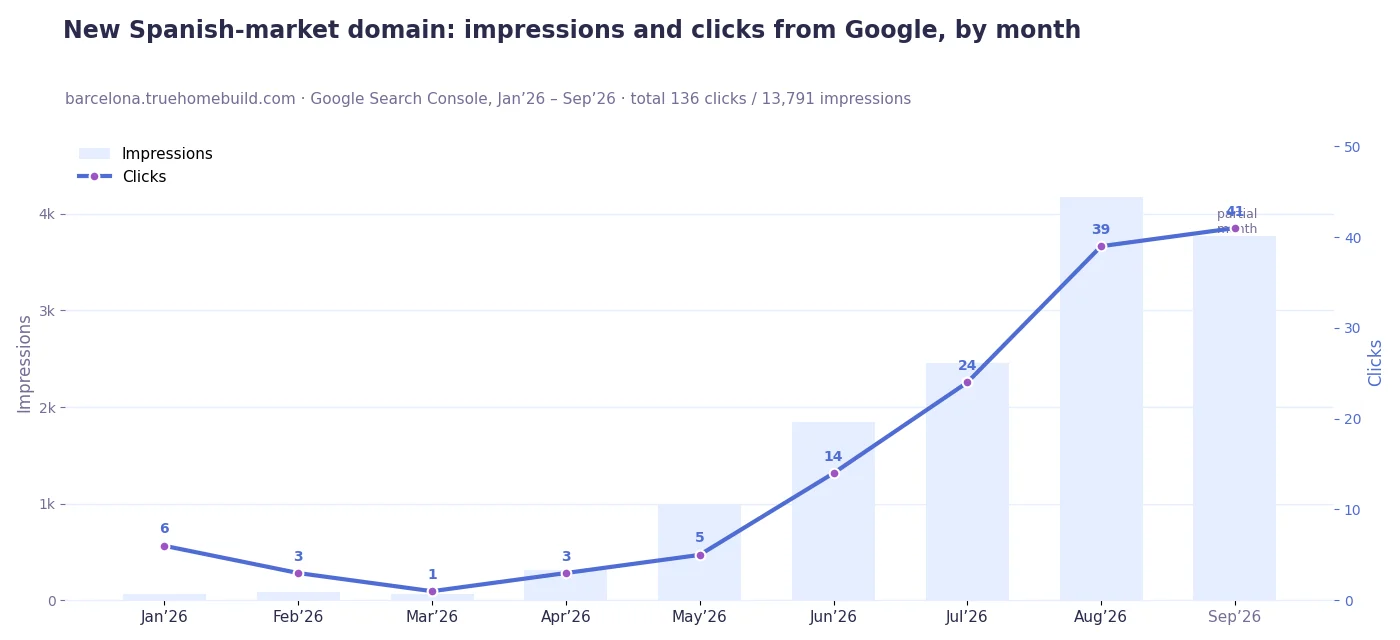
🇪🇸
Foreign-Market Web + SEO
Barcelona.truehomebuild.com
Native Catalan + Spanish construction site for Russian-speaking entrepreneur entering EU market.
54 queries in top-10
21 in top-3
466 organic impressions (90 days, brand-new domain)
Read full case study →
Industries we ship Jamstack for
💼
B2B SaaS Series A-C
Next.js application code for B2B SaaS marketing sites, signup flows, dashboards, and authenticated app shells. Headless CMS on Sanity or Contentful for marketing content, edge functions for auth and feature flags, Stripe and Clerk integration. Pairs with <a href='/b2b-mobile-app-development/'>B2B mobile app development</a> when the product surface spans web and mobile.
🏦
Fintech
Jamstack for B2B Fintech: edge-only headless architecture, SOC2-ready logging, KYC-gated content unlock, jurisdiction disclaimers managed as headless CMS content rather than hardcoded strings. FCA, BaFin, and FINRA language audit on every deploy. Audit logs written to append-only Postgres. Consent state held per session at the edge.
🔧
DevTools
Astro Starlight or Nextra for developer documentation, Next.js app router for the product surface, Markdown-first content with MDX components for interactive examples. GitHub-driven content publishing, npm version-aware doc routing, search via Algolia or Pagefind. The Jamstack stack is a natural fit for developer-led DevTools companies.
👔
Professional Services
Astro or Next.js for accountancy, legal, management consulting marketing sites: practice-area landing pages, partner bios with structured data, multilingual content via headless CMS, long-cycle nurture wired to HubSpot or Salesforce. ISR keeps thought-leadership content fresh without a full rebuild.
📰
Media and Adtech
CDN-first content distribution: Next.js with ISR for editorial sites, edge functions for ad-server integration and consent state, Sanity or Contentful for editorial workflow. AVIF image delivery, server-rendered OpenGraph for social, Algolia for site-wide search. Lighthouse 90+ on the editorial template.
🛒
E-commerce headless
Shopify Hydrogen, commerce-layer, or Saleor as the commerce backend, Next.js or Astro as the storefront. Headless commerce is the right pick when the storefront needs marketing-grade performance and the catalog is small to mid-size. Webhook-driven ISR for product updates, edge functions for cart and checkout, Stripe or Adyen for payments.
When teams pick a Jamstack agency
📈
Marketing site rebuild
Your VP Marketing inherited a slow WordPress build and the page speed report is hurting paid-search Quality Score and organic rankings. We rebuild as Next.js or Astro static, deploy on Vercel or Netlify, keep the same URLs, ship in 6 to 10 weeks. Post-Series-A B2B SaaS teams pick this most often.
🌐
Multi-region rollout
Locale-aware ISR with hreflang for en-US / en-GB / de-DE / fr-FR / es-ES. Sanity or Contentful for translation workflow, edge functions for geo-aware redirect, Cloudflare or Vercel for edge runtime. Common when a US-headquartered B2B SaaS team opens an EU office.
🛒
Headless commerce
Shopify Hydrogen storefront or commerce-layer + Next.js. The storefront ships as a static build with ISR for product pages, the cart and checkout run as edge functions, Stripe or Adyen handles payments. Common pick when the catalog is under 10,000 SKUs and storefront performance is the buyer experience.
💻
Dashboard SPA
Next.js App Router with server components for data-heavy views, client components for interactivity, edge runtime for auth and session state. Clerk or Auth0 for identity, Stripe for billing, Postgres or PlanetScale for data. The default pick for B2B SaaS Series B-C teams that want a single Next.js codebase for marketing and product.
📚
Documentation site
Astro Starlight, Nextra, or Docusaurus for developer documentation. MDX content collections, Algolia or Pagefind search, version-aware routing for npm package docs, GitHub-driven publishing workflow. Pairs naturally with a DevTools or platform product where docs ARE the marketing surface.
Blog at scale
MDX content collections, automatic OpenGraph generation per post, RSS feed, sitemap automation, Sanity or Contentful for non-technical author workflow. ISR revalidation on publish, Algolia search, related-post engine. Common for B2B SaaS teams that ship 4 to 12 posts per month and need editorial workflow outside the engineering repo.
Our 5-step Pipeline-First Jamstack Development methodology
1
Step 1 - Discovery and architecture decision
Two to three weeks. Stakeholder interviews with product, marketing, and engineering leads. URL inventory of the existing site, content audit, third-party integration map, performance baseline on the current build. Output is a written architecture decision record: which framework (Next.js / Astro / Gatsby), which headless CMS (Sanity / Contentful / Strapi), which host (Vercel / Netlify / Cloudflare), and which rendering mode each route uses (SSG / ISR / SSR / edge).
2
Step 2 - UX and content modeling
Three to four weeks. Design system audit, component library spec, content model in the headless CMS with locale and publishing-state fields, accessibility audit baseline (WCAG 2.2 AA), SEO meta plan with OpenGraph automation. We deliver a Figma component library and a Sanity Studio or Contentful content model that non-technical authors can use without engineering tickets.
3
Step 3 - Stack pick and dev environment
One to two weeks. Repo setup, CI on GitHub Actions, preview environments per PR on Vercel or Netlify, environment variable management, secret rotation policy, Sentry for runtime error tracking, Server-Timing telemetry, edge function scaffolding. Developers can ship their first PR by end of week 5 of the engagement.
4
Step 4 - Build and deploy
Six to twelve weeks depending on tier. We ship pages in production-grade order: marketing first, then signup, then dashboard, then auxiliary surfaces. Every PR has a preview URL, every merge to main hits production within five minutes. We do code review on every PR, write component tests for interactive elements, run accessibility checks on every preview build.
5
Step 5 - Performance audit and 90-day SLA
Two to three weeks of post-launch work. Lighthouse audit, Core Web Vitals review on field data from Chrome UX Report, edge cache header tuning, image format review, font-loading strategy review. We hold LCP under 2.5s and CLS under 0.1 across mobile and desktop for 90 days post-launch, with a monthly check-in. Pipeline-First Jamstack Development closes with a measurable performance contract.

Frequently asked questions

-
What is Jamstack and why should I choose it over WordPress?

Jamstack is an architecture where the frontend (HTML, JS, CSS) is pre-built or rendered on the edge, separated from the backend. The result: pages load in 200-500ms instead of 2-4 seconds, security surface is minimal (no DB on every request), and you can deploy globally on CDN. Compared to WordPress, you trade some content-editor convenience for big speed and security wins. Best for high-traffic marketing sites, B2B SaaS landings, ecommerce storefronts.

+
Which Jamstack frameworks do you work with?

Next.js (most common for marketing sites and SaaS), Astro (best Lighthouse scores out of the box), Nuxt (for Vue teams) and Gatsby (for content-heavy sites). We pick based on your team's existing stack, content velocity needs, and hosting preferences.

+
How does content management work without WordPress admin?

We pair Jamstack frontends with a headless CMS — Sanity, Strapi, Contentful, or Storyblok. Your editors get a familiar visual editor (often better than WordPress), with live preview. Changes publish in seconds via webhook to the static build pipeline.

+
What about SEO — does Jamstack hurt rankings?

Opposite — Jamstack typically improves SEO. Pages are pre-rendered (server-side or build-time), so Google sees fully-formed HTML. Lighthouse scores 90-100 are normal, which directly boosts Core Web Vitals signals. We always add Schema.org markup, hreflang for multilingual sites, and sitemap automation.

+
How much does a Jamstack site cost vs WordPress?

Jamstack development is typically 20-40% higher upfront vs WordPress (€10K-€25K vs €5K-€15K for a comparable scope), but hosting is 80% cheaper (Vercel/Netlify CDN at €0-€20/mo vs €30-€200/mo for WordPress hosting), and ongoing maintenance is minimal. Total cost of ownership flips after year 1 for most sites.

+
Do you migrate existing WordPress sites to Jamstack?

Yes — this is a common project. We keep all your existing URLs, content, and SEO equity. We build the new Jamstack frontend, pull content from your old WordPress (or migrate to a headless CMS), then switch DNS with zero downtime. Typical migration: 4-8 weeks for a 50-200 page site.

Continue exploring our development services
🏗
B2B website development
Sister service - CMS-agnostic web builds covering WordPress, Next.js, Astro, Gatsby. The right starting point when you have not yet picked between Jamstack and WordPress.
Learn more →
🏢
Corporate website
Multi-page corporate site builds for B2B brands - investor relations, careers, leadership bios, structured data. Astro or Next.js for content-heavy corporate marketing surfaces.
Learn more →
📱
B2B mobile app development
Native iOS and Android app development for B2B SaaS teams shipping a mobile companion to the Next.js web product. Pairs with Jamstack web builds.
Learn more →
💼
SEO for B2B SaaS
Pipeline-First SaaS SEO for Series A-C - product-led content engineering, comparison pages, AI search visibility. Pairs with Jamstack marketing site builds.
Learn more →
🇪🇺
SEO services Europe
EU-region SEO programme for B2B SaaS, Fintech, and Mittelstand brands scaling from US into the EU. Hreflang, locale-aware ISR guidance.
Learn more →
Plan your Jamstack project
Trusted by B2B SaaS, Fintech, DevTools, Professional Services, Media + Adtech, and headless e-commerce teams. USD project fees, fixed scope, written architecture decision record before kickoff. We ship a Pipeline-First Jamstack Development sprint with a 90-day post-launch SLA; we measure Lighthouse and Core Web Vitals on field data, not bench slides. Pipeline-First Jamstack Development • deployed 260530-qhg.
✓ No long-term lock-ins; project-based engagement
✓ Transparent USD pricing tiers ($25k / $55k / $120k)
✓ Direct engineering contact - no junior account managers
✓ US English content + USD invoicing + 90-day SLA
✓ Pipeline-First Jamstack Development on every engagement
Book a free Jamstack project scoping call
By submitting you agree to our Privacy Policy