
 Mon–Fri: 10:00 – 18:00
 Request a call




Google Business Profile optimization is mostly a small number of fields that decide whether you appear at all, wrapped in a large number of fields that barely move anything. Knowing which is which saves you weeks.
This guide is written for the person who owns the business, not for an agency reselling the service. It covers what actually changes rankings, what is busywork, and the mistakes that get profiles suspended.
What «optimization» actually means here
A Google Business Profile is the listing that appears in Maps and in the box of three local results above the organic links. Optimizing it means two separate things that often get conflated.
The first is completeness: filling in every field Google offers, accurately. This is a one-off job of a few hours and most businesses have never finished it.
The second is ongoing signals: reviews arriving, photos being added, questions being answered, the profile showing signs of an active business. This never finishes.
Neither of them is «SEO» in the sense of keywords and content. You cannot write your way into the map pack. What you can do is make the listing accurate, complete and visibly alive, and then earn the prominence that decides the ranking.
How Google decides which profiles to show
Google states three factors: relevance, distance and prominence. That ordering is not a priority list, and understanding the difference matters.
Distance
is mostly outside your control. Google measures from wherever the searcher is. A café three streets away wins searches near itself and loses them across town, and nothing you do to the profile changes that. This is why «why am I not ranking for my city» is usually the wrong question: you are ranking, just not from where you tested.
Relevance
is your categories, services and description matching what was searched. This is the part you control most directly and the part most businesses get wrong, usually in the primary category.
Prominence
is how well known the business appears to be: review volume and rating, mentions across the web, links to your site, and your site’s own standing in ordinary search. This is the slowest to build and the reason a new location cannot shortcut its way into the pack.
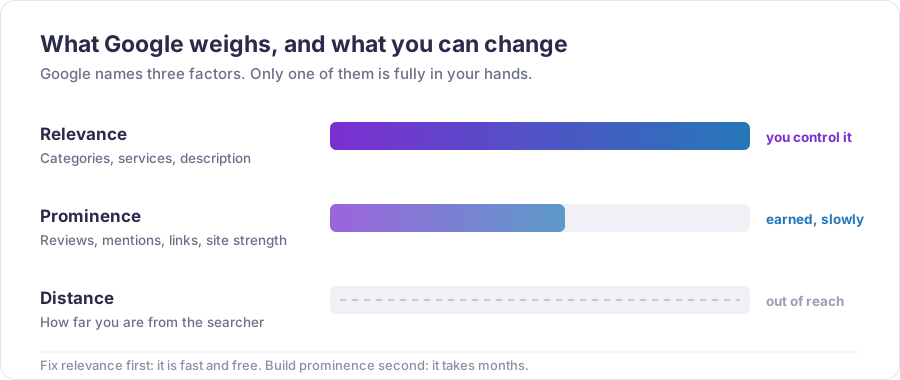
The practical order of work follows from this. Fix relevance first because it is fast and free. Build prominence second because it takes months. Ignore distance because you cannot change it, unless you are genuinely considering a second location.
The primary category decides more than anything else on the profile
If you change one thing after reading this, change this one.
Your primary category carries more weight for what you rank for than any other field in Google Business Profile optimization. A business listed as «Restaurant» when it is really a «Pizza restaurant» competes against every restaurant in the area rather than the handful of pizza places. The narrower and more accurate the category, the better the profile performs for the searches that actually bring customers.
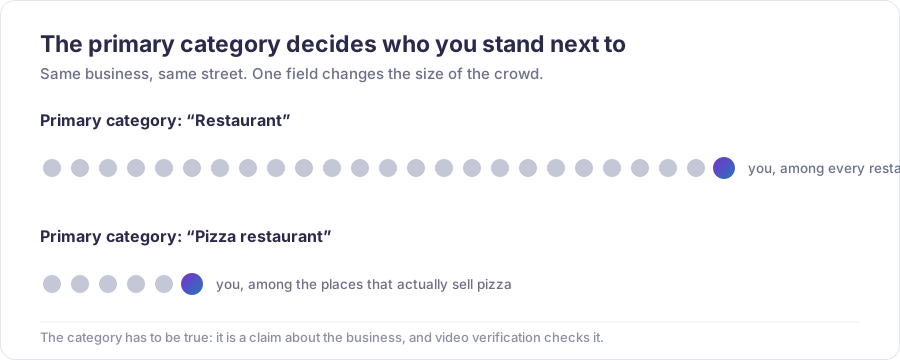
Secondary categories broaden reach, but they do not carry the same weight, and stuffing ten of them dilutes rather than helps. Pick the primary category that describes what you mostly do, then add only the secondaries you genuinely offer.
The check worth doing takes ten minutes. Search your main service in Maps, note the businesses ranking above you, and find out which categories they use. Several browser extensions expose this for free, and the answer often explains the entire ranking gap without any further analysis. If four of the top five use a category you do not have, that is your afternoon accounted for.
Two traps here. Categories change: Google adds and retires them regularly, and a category that was the best fit three years ago may have been replaced by something more precise. And a category is a claim about what the business is, so it has to survive a video verification. Listing yourself under a category whose typical premises look nothing like yours invites a suspension rather than a ranking.
Name, address and phone: consistency beats cleverness
Google cross-checks the details on your profile against what it finds elsewhere: your website, directories, social profiles, industry listings. Contradictions weaken confidence in the listing, and confidence is part of how prominently it gets shown.
The common inconsistencies are dull and easy to fix. A suite number present in one place and absent in another. An old phone number that still sits on three directories. «Street» written out on the site and abbreviated on the profile. A tracking number used on the website that appears nowhere else, which is worth avoiding entirely on the profile itself.
Pick the exact format you will use everywhere, write it down, and correct the sources that actually feed data onward rather than chasing every listing on the internet. The first ten matter and the next two hundred mostly do not.
The business name is the field where the temptation is strongest and the risk is highest. It must be the name on your signage and your paperwork. Adding your city or your main service to it is the most widely practised and most commonly punished trick in local search.
Getting verified without losing three weeks
Verification proves the business is real and located where you say. Google may ask for a postcard, a phone call, an email, or a video showing your premises, signage and equipment. Which method you get is not your choice.
Video verification has become common and it fails for avoidable reasons: filming in one continuous take is required, the address must be visible, the interior must match the category, and the person filming needs to show they have access to the space rather than standing in a doorway.

Timescales run from a couple of days to a few weeks. The delay is usually caused by an inconsistency between what the profile claims and what Google can confirm elsewhere, so making the address and phone number match your website and your other listings before submitting is the single best way to speed it up.
Description, services and attributes
The 750-character description is not a ranking factor in any direct sense. It is read by a person deciding whether to call you, so write it for them: what you do, who for, what makes the decision easy. Skip the keyword list, which reads badly and achieves nothing.
Services are different. Listing each service as its own entry, with a short description, gives Google explicit statements about what you offer and gives you something to match against long-tail searches. Most profiles have three services listed when the business performs twenty.
Attributes cover the practical filters people apply: wheelchair access, outdoor seating, women-owned, appointment required, languages spoken. They rarely change rankings and they regularly change decisions, particularly in accessibility and language, which matters if you serve a community that searches in a different language than the local majority.
Photos, and what actually matters about them
Profiles with photos get more engagement, and engagement is part of prominence. That much is uncontroversial. The overinterpretation is the advice to upload a photo every day, which produces a gallery nobody looks at.
What matters is coverage and freshness. The exterior as it looks from the street, so people recognise the place when they arrive. The interior. The team. The actual products or work. Photos updated when the premises change, rather than a set from 2021 showing a layout that no longer exists.

Customer photos count more than yours in how the profile looks to a visitor, and you get those by being worth photographing rather than by any setting in the dashboard.
Reviews are most of prominence
Review count, rating and recency all feed local ranking, and the profiles that dominate a map pack almost always have more reviews than everyone below them.
Three things matter more than the tactics people usually discuss. Ask everyone rather than only the customers you expect to be happy, because filtering requests violates Google’s policy and can cost you the profile. Reply to everything, quickly, because the reply is read by the next customer rather than by the reviewer. Keep the flow steady, because a burst of twenty reviews in a week after two years of silence looks exactly like what it is.
Volume is the lever most businesses have not pulled. A profile sitting on eleven reviews after four years of trading is normal, and it is competing against one with two hundred. The gap is rarely about service quality; it is that one of them asks and the other does not. Most owners overestimate how awkward the request is and underestimate how many customers would happily leave one if handed a link.
Where the review sits also matters more than people expect. Reviews mentioning the service and the area read as more specific to Google and to the person reading them, and you get those by asking at the moment the job finishes rather than in a monthly batch email.
We wrote separately about how to run this at scale on our review management page, including how to handle a negative review that is accurate.
The features almost nobody uses
Posts appear on the profile and expire, depending on type, in about a week. They are not a ranking factor in any measurable sense. They are useful when you have something time-bound: an offer, an event, a change of hours. Posting weekly because a checklist told you to is a waste of a good hour.
Questions and answers is the more interesting one, because most businesses do not realise the public can answer questions about them. You can and should seed the obvious questions yourself and answer them, before someone else answers wrongly.
Messaging, booking links and product listings each pay off in proportion to whether your customers use them. Turn on what you will actually monitor. An unanswered message thread is worse than no messaging button.
Service-area businesses and home addresses
If you go to your customers rather than the other way round, you can hide your address and set a service area instead. Plumbers, mobile clinics, consultants working from a flat. Google supports this properly.
Two things to know. A hidden address usually means a weaker position for searches close to that address, because the distance factor has less to work with. And listing a service area covering an entire country will not make you rank across it, since distance still applies from the searcher. Set the area you genuinely serve.
Renting a mailbox or a virtual office to claim a location you do not staff is the single most common cause of suspension. It is also easy for competitors to report.
What gets profiles suspended
A suspension removes the listing from Maps and search until you appeal, and appeals take weeks. The causes are consistent:
- Keywords stuffed into the business name, when the name on the profile is not the name on the door
- An address the business does not actually occupy, including virtual offices and a competitor’s building
- Multiple listings for the same location, often created accidentally over the years
- Category or business type that does not match what a video verification shows
- Sudden edits to the name, address and category all at once, which reads as a hijacked listing
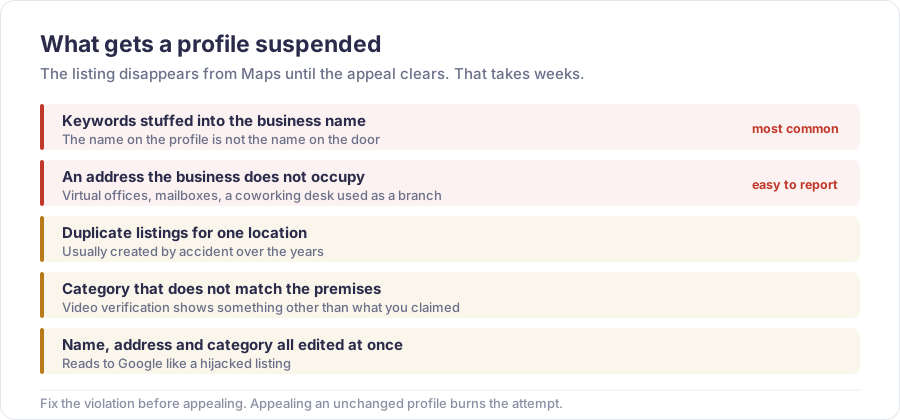
The keyword-in-name one deserves emphasis because it is so widely done. It works until it does not, and the penalty is losing the listing entirely rather than dropping a few positions.
If a suspension happens, the sequence matters. Fix the underlying violation before appealing, because appealing an unchanged profile burns the attempt. Gather proof that the business operates where it claims: signage photos, a utility bill, business registration, anything showing the address is real and occupied. Then submit the reinstatement request once and wait, rather than filing repeatedly, which slows the queue rather than speeding it.
Recovery typically takes weeks. A soft suspension leaves the listing visible but unverified and is usually quicker. A hard suspension removes it from Maps entirely, and during that period every search that used to find you finds a competitor. This is the reason to avoid the borderline tactics rather than an abstract concern about rules.
Beyond Google
Apple Maps matters if a meaningful share of your customers use iPhones, which in some markets is most of them. Bing Places takes ten minutes. Whether the wider directories are worth the effort depends on your market, and the honest answer for most businesses is that a handful of relevant local and industry directories beat a subscription that blasts your details to five hundred sites nobody visits.
Does this affect what AI assistants say about you?
Increasingly, yes. When someone asks an assistant for a recommendation in a place, the answer is assembled from the same public signals that feed local search: your listing, your reviews, and what other sites say about you.
The practical implication is that the work overlaps rather than splitting into two projects. An accurate, complete profile with recent reviews and consistent details across the web is what both systems read. Where the approaches diverge is in how you get mentioned in text the models have seen, which we cover under generative engine optimization.
Measuring whether any of it worked
The profile’s own performance panel is the place to start, and the metrics worth watching are the ones that indicate intent: calls, direction requests, website clicks, and bookings. Raw views tell you very little.
Track how people found you as well. Searches split into direct, where someone looked for your name, and discovery, where they searched a category and found you. Growth in discovery is the number that shows optimization is working. Growth in direct usually means your other marketing is working.
One caveat that saves confusion: your own rank check is unreliable, because Google personalises by location. Checking from your office tells you how you rank at your office. Use a tool that queries from a set grid of points across your service area, or accept that the impression is anecdotal.
Two more things worth wiring up before you judge results. Tag the website link on your profile with campaign parameters, so visits from the listing are separable in analytics from the rest of your traffic. Without that, the profile’s contribution disappears into direct traffic and stays invisible in every report you look at afterwards.
And give it a fair window. Category and service changes can show within a couple of weeks. Anything driven by prominence, which includes most competitive terms, moves over months. Judging a GBP optimization effort after three weeks produces the wrong conclusion in both directions: you either abandon something that was working or credit a change that was seasonal.
If you have more than one location
Managing several profiles by hand drifts within months. Google supports location groups for bulk management, and past a handful of locations the rules change enough that it becomes its own discipline. We cover that on the local SEO page, including the problem where a company’s own location pages compete with each other.
Common questions
Is a Google Business Profile free?
Yes, creating, verifying and managing it costs nothing. What is not free is the time, and the paid services that exist are selling that time rather than access.
Can I have a profile without a storefront?
Yes, as a service-area business, provided you actually meet customers at their location. What you cannot do is invent a premises address to get one.
How long until the profile shows up?
Usually within days of verification for your own business name. Ranking for competitive category searches takes months, because that depends on prominence, which is earned rather than configured.
How often should I update it?
Update facts whenever they change, which is the part that actually matters and the part most often neglected: holiday hours, a new phone number, services you no longer offer. Everything else, including posts, on a cadence you can sustain rather than one a checklist prescribes.
Does replying to reviews help rankings?
Google recommends responding, and replies plainly affect whether a reader chooses you. Treating the reply as a conversion element rather than a ranking trick gets you to the right behaviour either way.
What is the single most common mistake?
The wrong primary category, followed closely by a name that does not match the signage. The first quietly costs you rankings for years. The second can cost you the listing.
Where to start
Check your primary category against the businesses ranking above you, list every service you actually perform, and make your name, address and phone number identical across your site and your listings. Those three take an afternoon and account for most of what a paid audit would tell you.
If you would rather have someone look at it, send us your business name and city. We will check the profile, the categories and where you stand across your service area, and tell you what we would change first. That review is free.